
2024-2025 Annual Report of the French Language Services Commissioner of Ontario
Commissioner’s Message - Drawing on our history to build our future: I am pleased to present the Office of the Ombudsman of Ontario’s sixth Annual Report of the French Language Services Commissioner, for the period of October 1, 2024 to September 30, 2025.
Table of contents
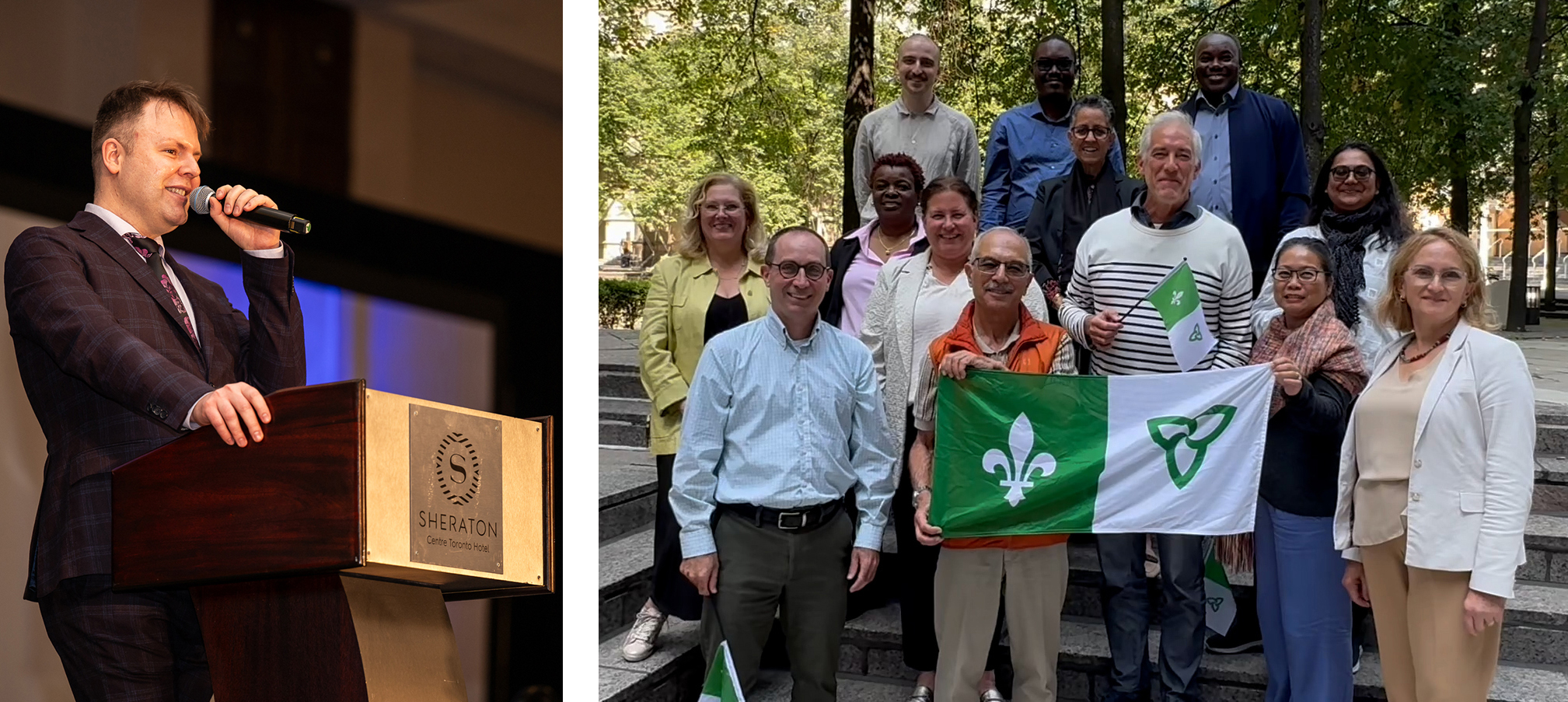
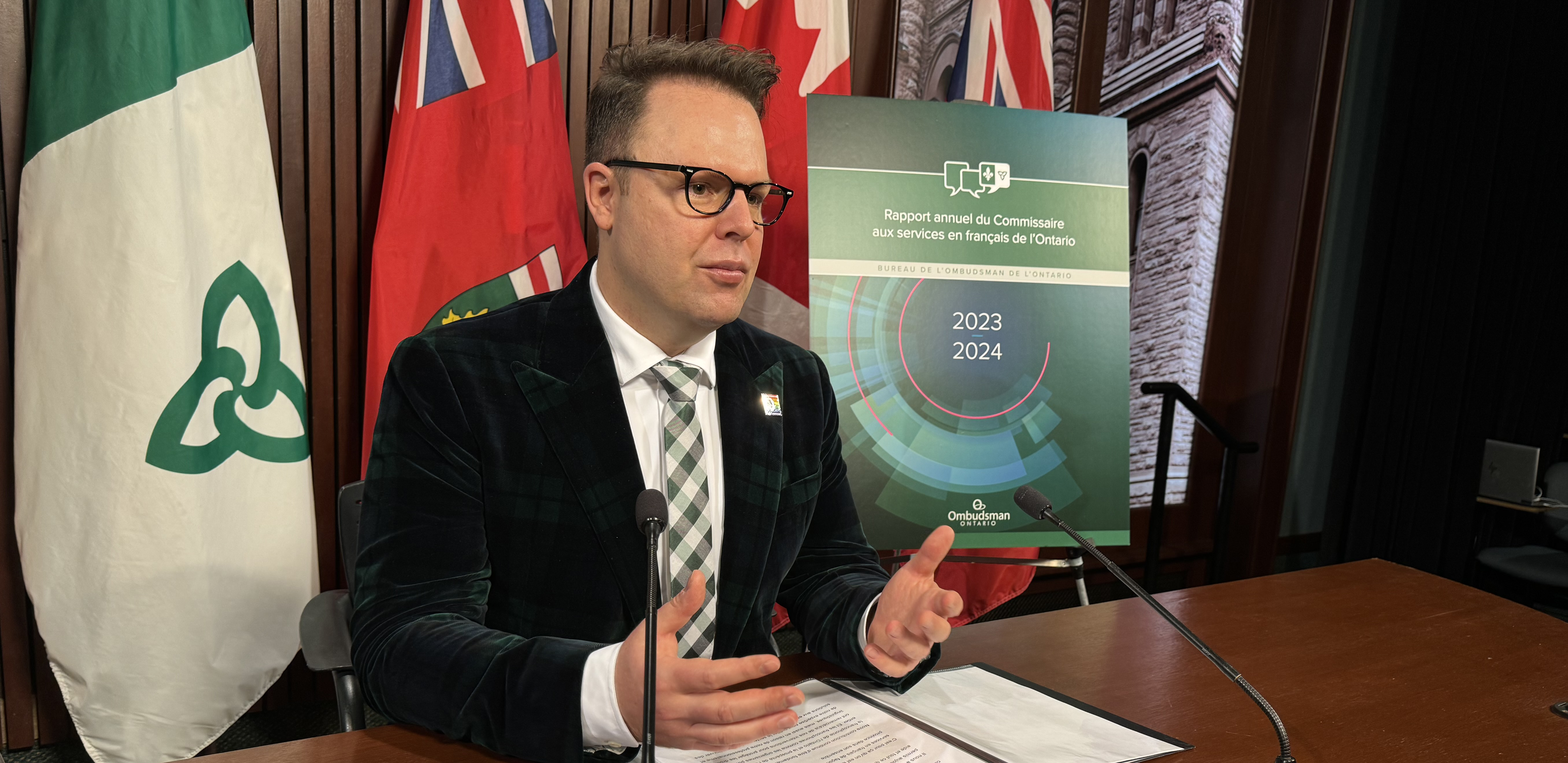
Press conference
Office of the Ombudsman of Ontario
We are dedicated to being an effective agent of positive change for the people of Ontario and ensuring that their rights are respected and that public services are delivered with professionalism and fairness.
Acknowledgement of territory
The Ombudsman of Ontario acknowledges that the province of Ontario is situated on the lands and territory of more than 130 unique First Nations, each with its own distinct cultures, languages, and histories that predate the existence and boundaries of the province.
We acknowledge the existence of political confederacies on these lands that predate both Canada and Ontario, such as the Three Fires Confederacy and the Haudenosaunee Confederacy, who among themselves have treaties and relationships that make up the dynamic landscape of this province.
We humbly recognize that we have collective responsibilities and obligations within the more than 40 treaties in Ontario, such as Treaty 3, Treaty 9, the Robinson Superior and Huron Treaties and the Williams Treaties.
We recognize that Indigenous peoples who have cared for these lands for millennia have been dispossessed by colonization, and we seek to find ways to remedy both historic and ongoing wrongs.
We are grateful to have travelled and worked in First Nation territories and with Métis and Inuit peoples in Ontario since the inception of the Ombudsman 50 years ago.
Ombudsman Ontario is committed to building respectful relationships with First Nation, Inuit, and Métis people and communities in Ontario through trust and transparency in order to be able to provide more services for a shared better future.
Commissioner’s Message
Drawing on our history to build our future
I am pleased to present the Office of the Ombudsman of Ontario’s sixth Annual Report of the French Language Services Commissioner, for the period of October 1, 2024 to September 30, 2025.
This year has been historic for Francophones in Ontario: September 25, 2025 marked the 50th anniversary of the Franco-Ontarian flag. This is a major anniversary in our shared history, whether we have lived here for a long time or only recently arrived. It is an anniversary that reminds us that obtaining a driver’s licence while being served in French at ServiceOntario or going to the hospital and obtaining care in French are achievements that are due to those who had the courage, determination and resilience to ensure a place for the French language in Ontario.
The French Language Services Act is a cornerstone of Ontario’s legislation: it guarantees a large portion of our services in French in a constantly evolving province. It is a great achievement, championed by people who believed in and defended the place of French in our province, such as Bernard Grandmaître, who introduced the French Language Services Act and who passed away earlier this year.
French language services are not just legal obligations or issues of administrative fairness; they are milestones in our shared history. People who created a flag, songs that became anthems, theatre, TV, radio, digital productions, legislation, regulations – all contribute to that history.
Speaking French, and using services in French, is a way to recognize this history. It is also a simple gesture that signals our commitment to continue to build our Francophonie, so that we can celebrate new achievements, new Franco-Ontarian creations, new steps forward.
As the French Language Services Commissioner, and with the support of the entire Office of the Ombudsman, my team and I work to help preserve language rights in Ontario on a daily basis by resolving cases that affect you directly.
Our intervention often has a profound impact on the province’s Francophones. I am thinking, for example, of the Fire Code, which has been revised and is available in French for the first time since the promulgation of its first edition in 1981, and which will come into force in January 2026. This is a concrete example of how our work leads to concrete, often long-term results for Francophones in many sectors.
I am also thinking of a mother who found it difficult to obtain services in French from the Office of the Chief Coroner and one of its regional offices after her son died in an accident. She had a very difficult time trying to understand the explanations and reports in English provided by the Coroner’s office. Even though interpreters were sometimes present during some conversations, she found the process very trying. She told us: “It’s not easy to translate all the words. I speak a little English, but in situations like that, I have a lot of trouble being able to really express myself, because it’s very emotional. [...] It also affects the other members of the family who are put aside because we can’t have letters in French.” [Translation]
After we intervened in this case, the Coroner’s office made sure all communications with this mother were in French. In addition, the organization conducted an analysis of the bilingual capacity of its staff across the province and reviewed its offer of services in French for families and the general public.
Getting to know Ontario’s Francophones
As in previous years, we met with hundreds of Francophones from across Ontario during the period covered by this report, in their communities.
We witnessed and heard about their daily realities and saw firsthand the significant impact and positive influence of our interventions to ensure the French Language Services Act is respected and services in French are improved overall in Ontario.
We have helped hundreds of Francophones in their language, whether on issues specifically related to the French Language Services Act or more broadly on issues that fall under the jurisdiction of the Ontario Ombudsman.
In today’s world of information, sometimes misinformation, and often artificial intelligence, it is sometimes difficult to know where to turn to see clearly. When they came to us, French-speaking people found concrete, reliable and accurate answers, and received much-appreciated help. Here are some of the comments they shared with us (translated from French):
- “You helped me a lot. Thank you very much for your help. I liked the way you intervened.”
- “Finally, they will take care of Francophones. If I go back to the hospital, I will express myself in French [...] Congratulations and hats off to you for your work!”
- “I’m very happy that we took another small step in the right direction.”
- “Thank you [...] for putting so much effort into this file.”
As we celebrate the 50th anniversary of the Franco-Ontarian flag, 2025 also marks the 50th anniversary of the Office of the Ombudsman, which has proven itself since 1975 as an avenue for protecting and improving government services and which has been monitoring the language rights of Francophones in Ontario since 2019.
We have developed this expertise by gaining the trust of the Legislative Assembly, governments, the public service, the public sector in general and, above all, the public. It is thanks to all those who shared personal stories with us and our rigorous work of engagement and connection with Ontarians, that our interventions bring concrete results.
In this report, you will see the results of our efforts in key areas such as daycares, government communications, road signage, health care, the management of government agencies designated by regulation, the map of designated areas, access to justice in French and post-secondary education, to name a few.
This report reinforces the importance of our institution’s role for Ontario’s Francophones and demonstrates, once again, the value of our work.
Happy reading!
Carl Bouchard,
French Language Services Commissioner of Ontario
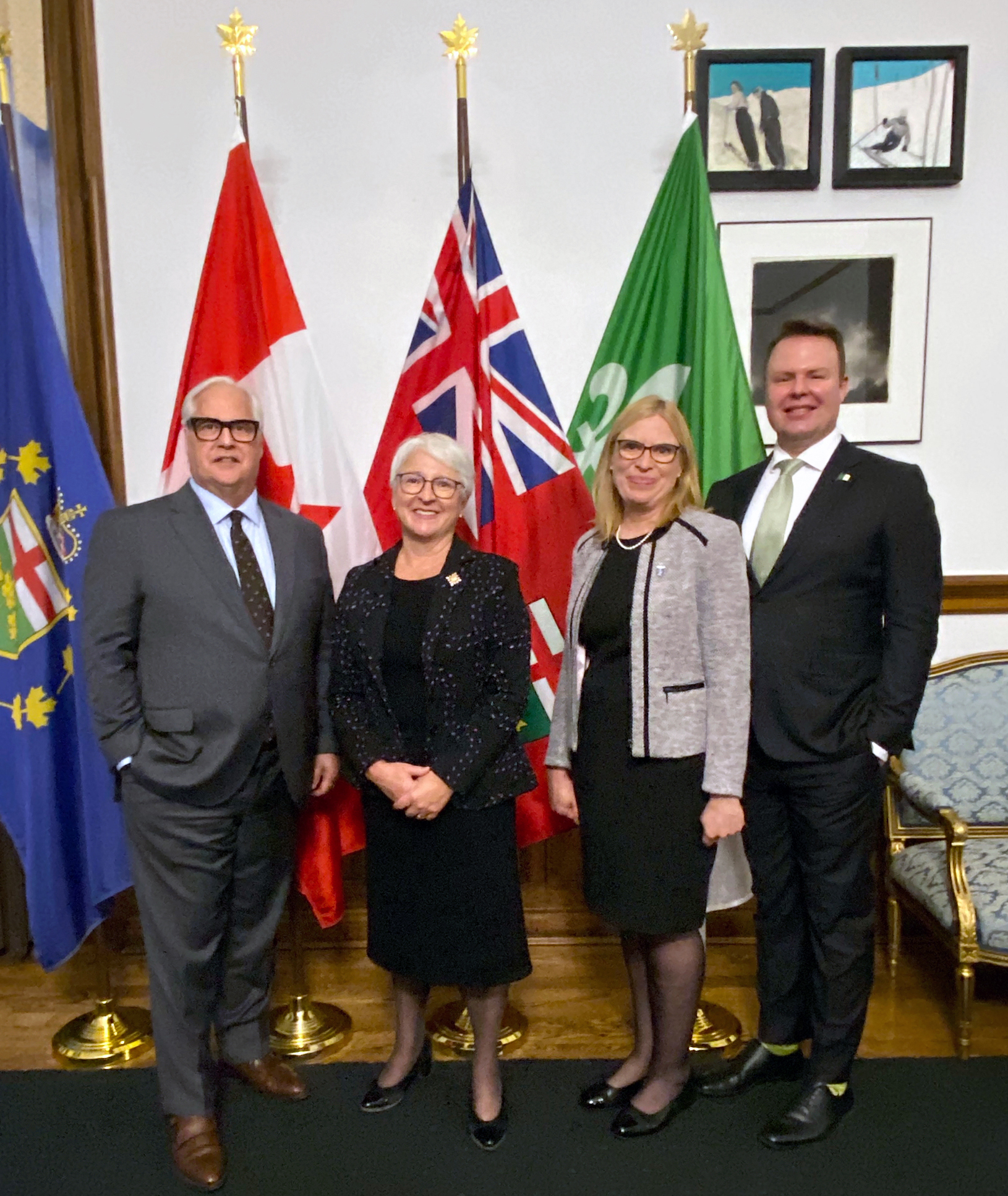
“As we honour [Ombudsman Ontario’s 50th anniversary] today, we also recognize the remarkable work of the French Language Services Unit.
Mr. Bouchard, please allow me to express to you and your team my sincerest thanks for your unwavering commitment to promoting and defending the linguistic rights of Francophones in our province.
As you know, this year also marks the 50th anniversary of the Franco-Ontarian flag — a powerful symbol of our identity.
Like a sturdy flagpole, your Office embodies the essential support that allows the Franco-Ontarian flag to fly proudly.” [Translation]– Lieutenant Governor Edith Dumont, speaking at a reception for Ombudsman Ontario’s 50th anniversary, October 29, 2025 [Translation]
Meeting with and listening to the Franco-Ontarian community

- April 9, 2025: French Language Services Commissioner Carl Bouchard with Cameron Love, President and Chief Executive Officer of The Ottawa Hospital, Ottawa.
- April 10, 2025: The Commissioner with Désir Saint-Phard, Executive Director of the Centre d’établissement, de soutien et d’orientation communautaire (second from left) and his team, Ottawa.
- April 9, 2025: The Commissioner with Le CAP Executive Director Rachel Gouin (right) and her team, Ottawa.
- April 10, 2025: The Commissioner with Réseau des services de santé de l’est de l’Ontario Chief Executive Officer Normand Glaude (far left) and his team, Ottawa.
- April 10, 2025: The Commissioner with AFFYA Pour Tous President Marie-Florence Aboké (right) and Georges Bléou (left), Ottawa.
- April 10, 2025: The Commissioner with Executive Director Mélanie Routhier Boudreau (right) and President Trèva Cousineau (left) of the Mouvement d’implication francophone d’Orléans, Ottawa.
- April 10, 2025: The Commissioner with the Action ontarienne contre la violence faite aux femmes team and Executive Director Maïra Martin (on screen), in Ottawa.
- April 10, 2025: The Commissioner with Patricia Dostie (left), Executive Director of the Association pour l’intégration sociale d’Ottawa, and Julie Beaulieu (right), Director of Adult Services, Ottawa.
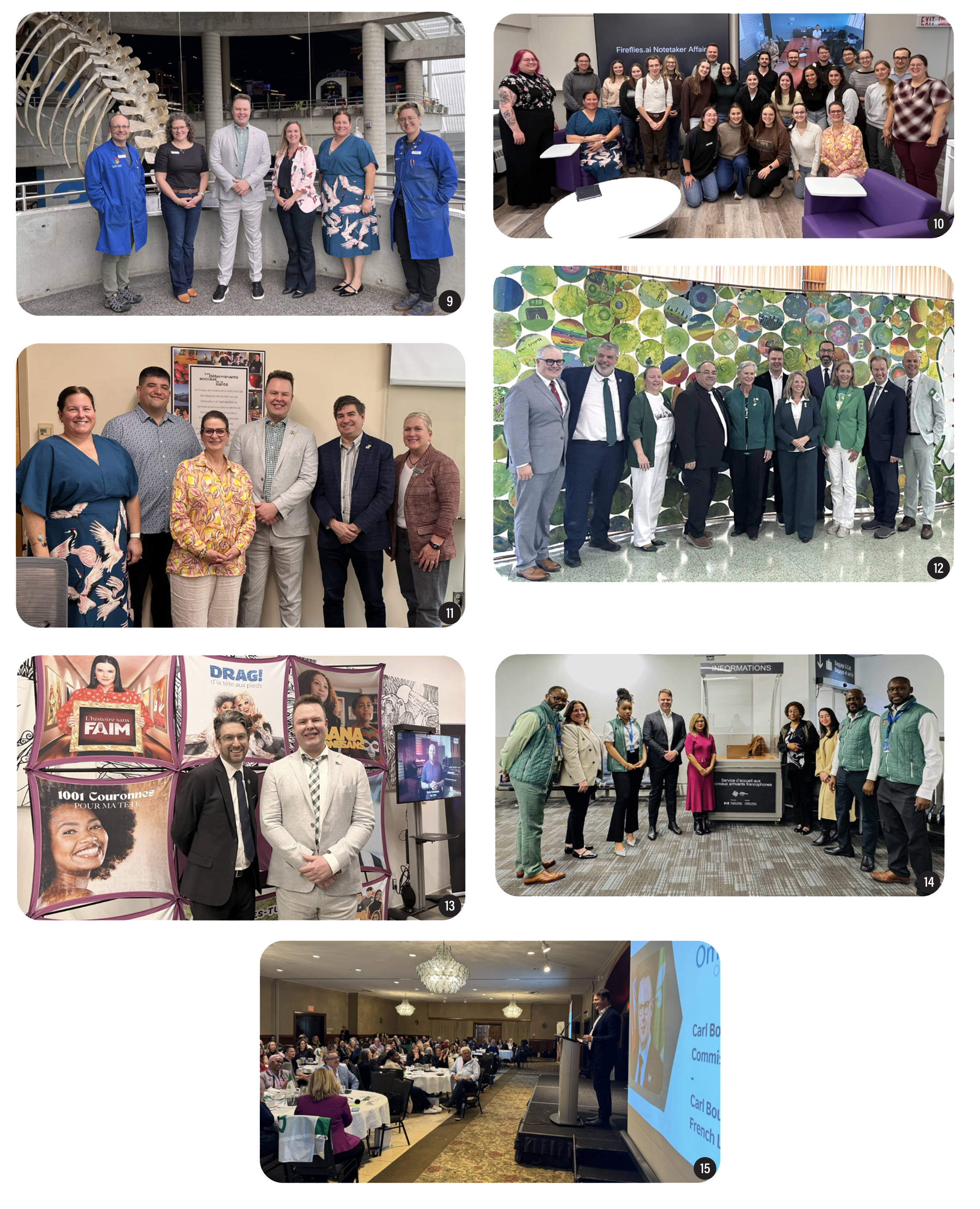
- September 24, 2025: French Language Services Commissioner Carl Bouchard and French Language Services Unit Director Anne Sophie Leduc (second from right) with staff at Science North, Sudbury.
- September 24, 2025: The Commissioner and French Language Services Unit Director (seated second from left) with students from the Northern Ontario School of Medicine, Sudbury.
- September 24, 2025: Commissioner Bouchard and Director Leduc with Michael Green, President and Vice Chancellor of the Northern Ontario School of Medicine, and team members, Sudbury.
- September 25, 2025: The Commissioner with organizers of the ceremony for the 50th anniversary of the Franco-Ontarian flag, University of Sudbury, Sudbury.
- September 24, 2025: The Commissioner with Xavier Brassard-Bédard, Chief Executive Officer of TFO, Sudbury.
- November 8, 2024: Commissioner Bouchard and Director Leduc with Centre francophone du Grand Toronto staff at the Welcoming Services for Francophone Newcomers booth at Toronto Pearson International Airport, Mississauga.
- October 29, 2024: The Commissioner speaks at the plenary session of Entités 1 and 2, London, Ont.
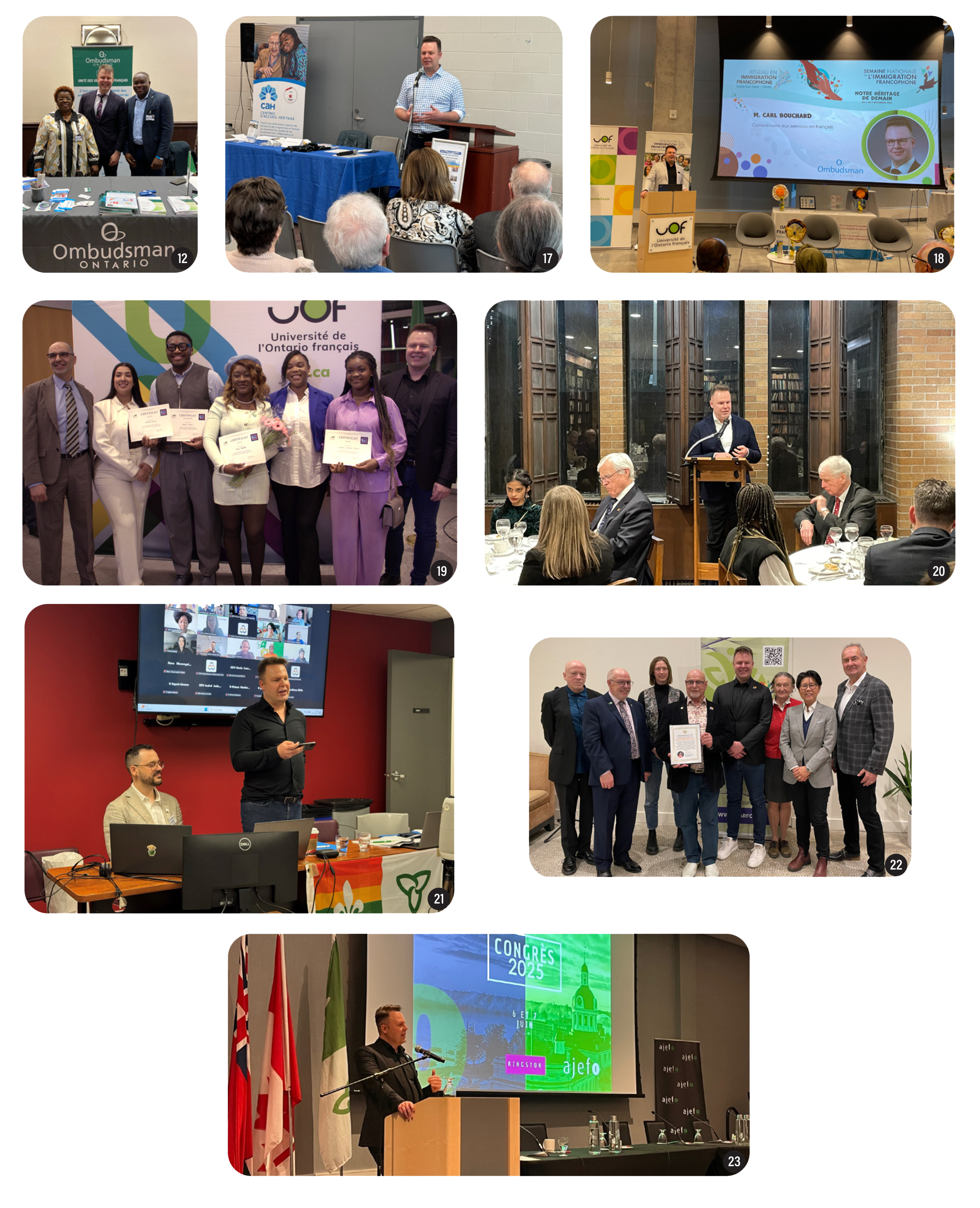
- February 28, 2025: French Language Services Commissioner Carl Bouchard with members of the French Language Services Unit at the Black History Month Gala organized by the Centre francophone du Grand Toronto, Toronto.
- March 6, 2025: The Commissioner speaks at the Salon de Vie Active seniors’ centre, Mississauga.
- November 1, 2024: The Commissioner delivers a speech at the launch of the 12th Semaine nationale en immigration francophone au Canada, at the Université de l’Ontario français, Toronto.
- February 26, 2025: The Commissioner with winners of the “Délie ta langue” competition at the Université de l’Ontario français, Toronto.
- March 6, 2025: Commissioner Bouchard delivers a speech at Massey College, on the occasion of Francophonie Month, Toronto.
- September 30, 2025: The Commissioner speaks at the annual general meeting of FrancoQueer, Toronto.
- April 25, 2025: The Commissioner with members of the Fédération des aînés et des retraités francophones de l’Ontario and guests at the official launch of the Réseau VIVRE+ Fierté, Toronto.
- June 7, 2025: The Commissioner delivers a speech at the annual conference of the Association des juristes d’expression française de l’Ontario, Kingston.
Our work and methods
About the Office of the Ombudsman
The Ombudsman is an independent, impartial and non-partisan Officer of the Ontario Legislature, appointed by all parties, whose role is to ensure that the provincial government and public sector serve people in a way that is fair, accountable, transparent and respectful of their rights.
Founded 50 years ago in 1975, the Office of the Ontario takes complaints about the administrative decisions and actions of more than 1,000 public sector and government bodies in Ontario. Over the past five decades, the Office of the Ombudsman has championed transparency, fairness and accountability, working with democratic institutions in Canada and around the world. Its mission is enshrined in 2024 United Nations resolution, which recognizes the essential role of ombudsman institutions in the promotion and protection of human rights, good governance and the rule of law.
The Ombudsman’s jurisdiction includes provincial government ministries, agencies, corporations, boards, commissions and tribunals, as well as municipalities, universities and school boards. As of May 1, 2019, the Ombudsman’s jurisdiction was extended to child protection services and French language services. Throughout its history, long before assuming the responsibility of monitoring compliance with the French Language Services Act, Ombudsman Ontario has helped French-speaking Ontarians with a wide range of issues with government and broader public services, and continues to do so.
We intervene to resolve or investigate issues involving government and public sector administration and make evidence-based recommendations for corrective action when necessary. We do so based on complaints or on our own initiative, and are recognized internationally for the calibre and impact of our work. The Ombudsman’s recommendations have been overwhelmingly accepted by the government, resulting in numerous reforms.
We provide free assistance to people who need help accessing public services or having their rights respected. Notable exclusions to our jurisdiction are the decisions of judges and the functions of any court, the conduct of elected officials (including the Premier and Cabinet), as well as hospitals and long-term care homes. However, we can take complaints about French language services provided by certain hospitals, long-term care homes and other bodies specified in the regulations to the French Language Services Act.
The Ombudsman publishes reports with recommendations when he conducts individual and systemic investigations. He also publishes an Annual Report, which includes complaint statistics and highlights of the work of all areas of our Office – including the French Language Services Unit.
Between April 1, 2024 and March 31, 2025, the Office of the Ombudsman received 30,675 cases (complaints and inquiries).
Role of the French Language Services Commissioner
Ontario’s French Language Services Act (FLSA) was passed in 1986 and has been in effect since 1989. It ensures the right to obtain provincial government services in French at head or central offices of government agencies, as well as their offices in or serving designated areas throughout the province.
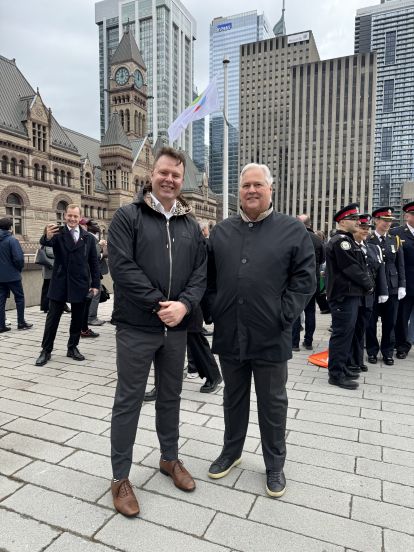
The French Language Services Commissioner plays an important role in ensuring compliance with these obligations. Reporting to the Ombudsman, the Commissioner is responsible for monitoring compliance with the FLSA and recommending ways to improve the delivery of government services in French.
Under the FLSA, the Commissioner can review complaints about the offer of services in French by or on behalf of government agencies and institutions of the Legislature. These include ministries, boards, commissions and corporations that have a majority of members or directors appointed by the Lieutenant Governor in council, as well as agencies designated in Ontario Regulation 398/93.
The Commissioner leads the French Language Services Unit, a team of Early Resolution Officers and Investigators that is supported by the Ombudsman’s Legal Services, Communications, Finance, Information Technology, and People and Culture teams. The Commissioner and the Director of the French Language Services Unit are members of the Ombudsman’s Executive Management Team.
The Commissioner and our French Language Services Unit actively promote French language rights in Ontario, engage in outreach, review and analyze complaints and trends, conduct investigations related to compliance with the Act, prepare reports which include recommendations, and monitor implementation of these recommendations. The benefits of this work, done in collaboration and with the support of our entire Office, are tangible and significant.
As part of our Office, the Commissioner is completely independent of government, political parties, individual complainants and interest groups. The Commissioner has the power to investigate on his own initiative – that is, without a complaint – and to make recommendations to improve the delivery of French language services. These recommendations are based on evidence gathered through the assessment of complaints and interaction with individuals, government agencies and officials, as well as an analysis of relevant legislation.
The importance of cases
As an independent and impartial institution, we have a special relationship with the people of Ontario. The complaints we receive allow us to hear directly from those who feel their rights are not being respected or who believe they are being treated unfairly by the government. By listening to complainants and making inquiries with government and public services, we have a unique perspective that allows us to assess whether services are well-matched to needs, and to make recommendations to remedy service gaps where necessary.
We welcome complaints from people who feel their rights have been ignored. We seek to fully understand each case, identify the facts, and measure the impact of the lack of French language services on people’s lives. We are here to help: Our teams also use our authority under the Ombudsman Act if a case raises questions of fairness that fall outside of the French Language Services Act.
Proactive work
By virtue of our ongoing interactions with key stakeholders, our one-on-one conversations with members of the Franco-Ontarian community, and our engagement with government and various agencies and organizations, we can often resolve issues long before they lead to complaints. We also build productive and appropriate relationships with the government, its agencies, third parties, Ontario’s diverse Francophone communities and all those who have an interest in French language services across the province.
The Commissioner also meets regularly with counterparts across the country and around the world, such as the members of the International Association of Language Commissioners (IALC) and the international Francophone ombudsman association, l’Association des Ombudsmans et Médiateurs de la Francophonie (AOMF).
Communications and outreach
Listening to French-speaking Ontarians is an integral part of the role of the French Language Services Commissioner, the Ombudsman of Ontario and the French Language Services Unit. Since 2019, the Ombudsman has been committed to ensuring that the Commissioner is proactive, engaged, and accessible to the Francophone community.
Throughout the year, we went to meet Francophones in their communities, whether it was at events, institutional meetings or more informal exchanges. This presence on the ground has strengthened ties and provided us with a better understanding of local realities.
During the period covered by this report (October 1, 2024 – September 30, 2025), we increased our communications and outreach activities with the government and with Francophone communities.
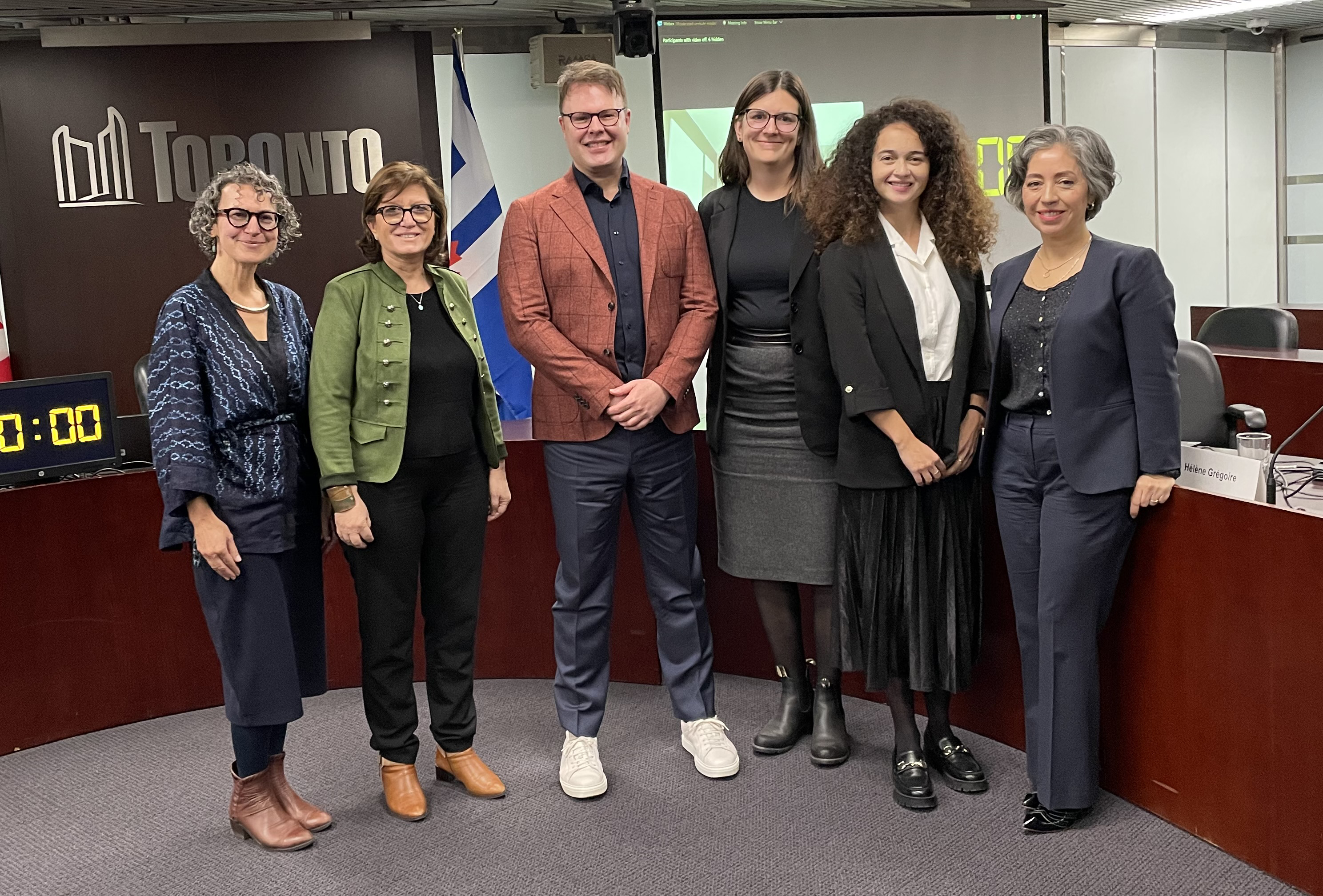
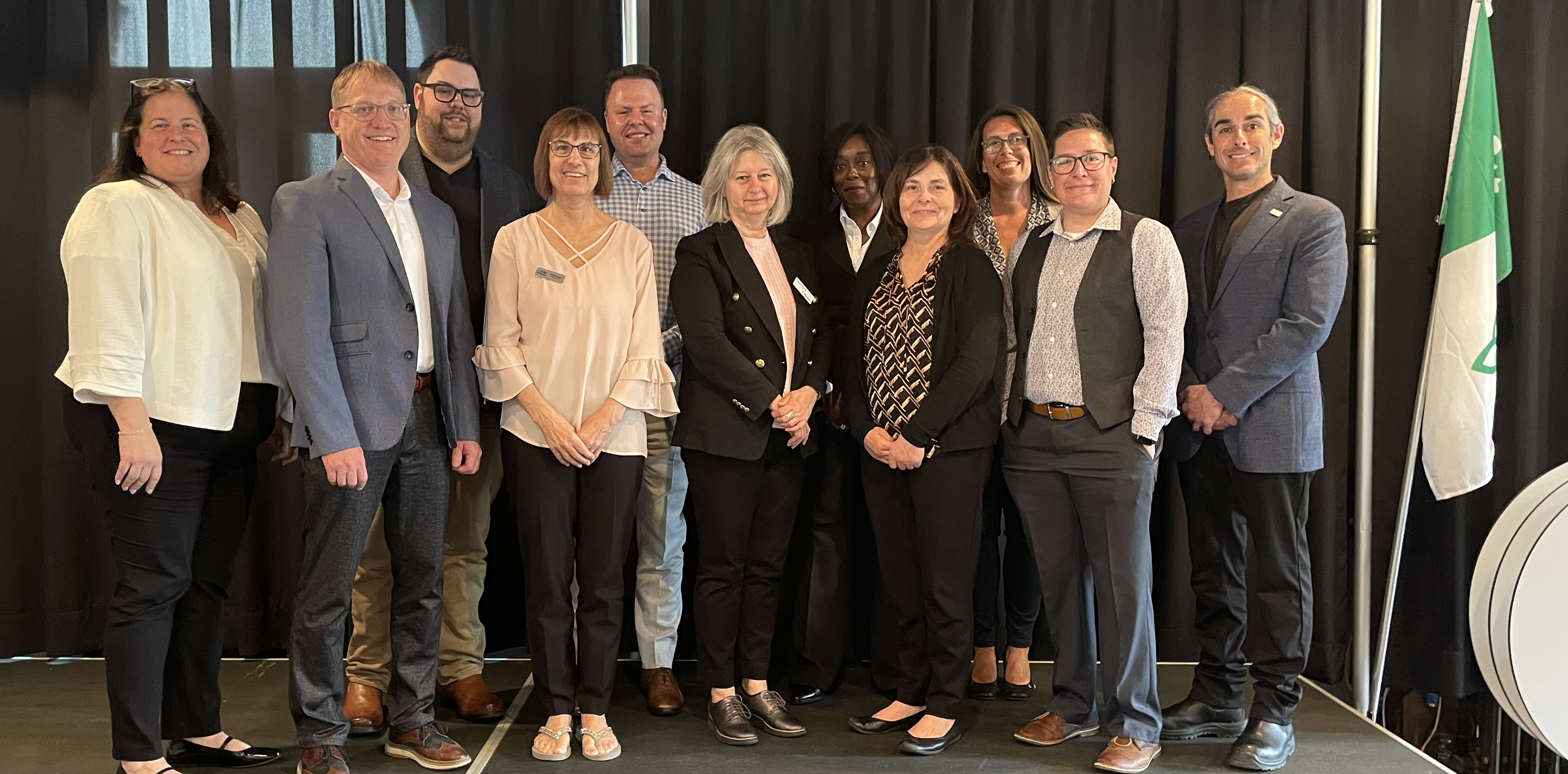
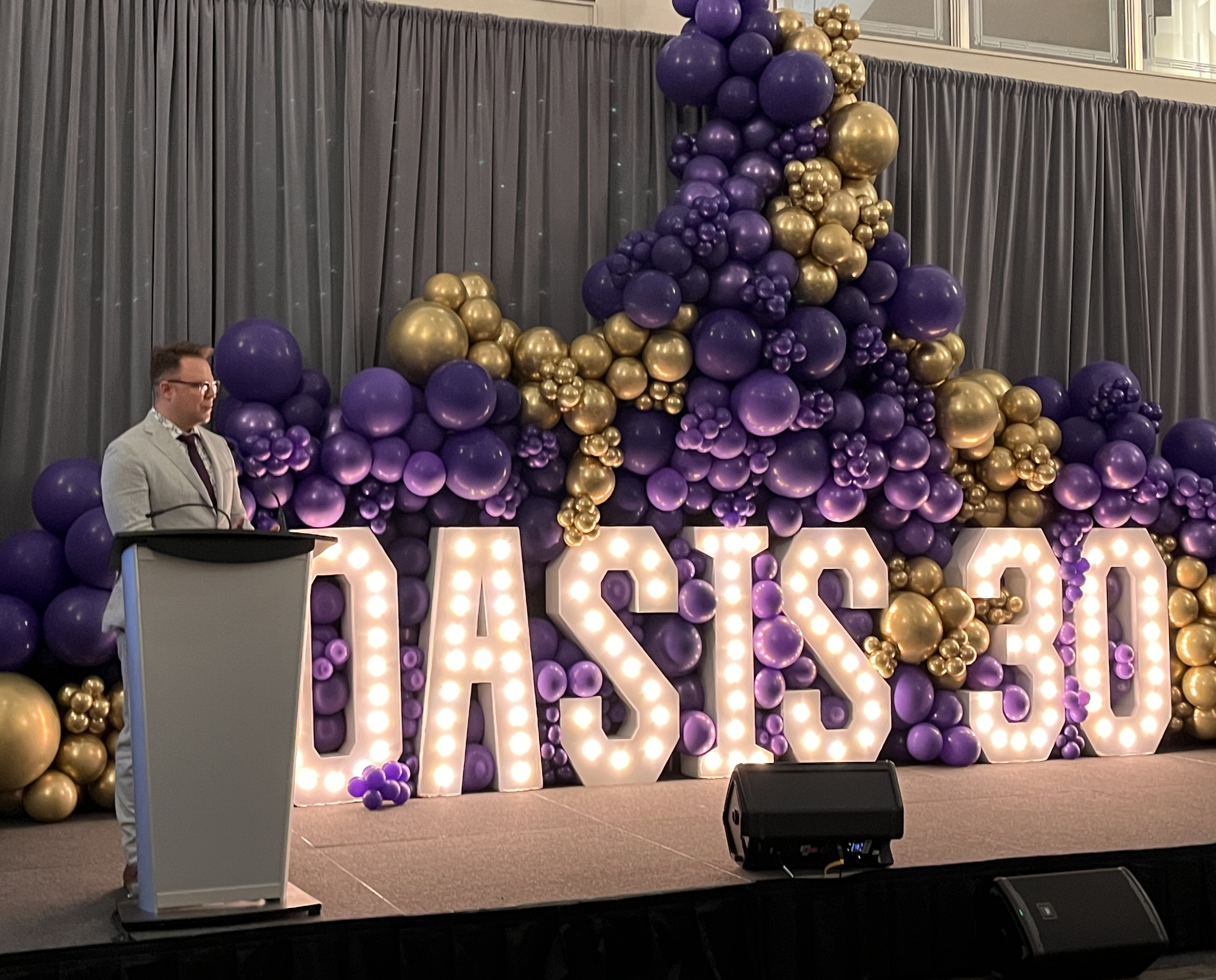
Commissioner Carl Bouchard held some 15 meetings with government officials, and participated in person in 23 events in the community, including the annual convention of the Assemblée de la francophonie de l’Ontario (AFO), the Black History Month Celebration Gala of the Centre Francophone du Grand Toronto, Francophonie Week, the 30th anniversary of the Oasis Centre des femmes annual conference of the Association des juristes d’expression française, the first convocation of the Université de l’Ontario français and the celebrations of the 50th anniversary of the Franco-Ontarian flag. On these occasions, he gave 18 speeches.
He met with organizations representing the Francophone community on 56 occasions, most of them in person. These visits allow us to experience the vitality of Francophone communities, to better understand their specific challenges and to celebrate their successes. They also reflect the Commissioner’s desire to meet with Ontarians where they live and work, and to fully understand their realities of accessing services in French across the province.
On June 4, 2025, Commissioner Bouchard and the Information and Privacy Commissioner, Patricia Kosseim, spoke directly to Ontario’s Francophones during a live, hybrid (in person and online) event held at the Collège Boréal campus in Toronto. In the presence of the Lieutenant Governor of Ontario, the Honourable Edith Dumont, the commissioners introduced their respective offices to participants, spoke about their mandates and best practices, and answered questions from the audience.
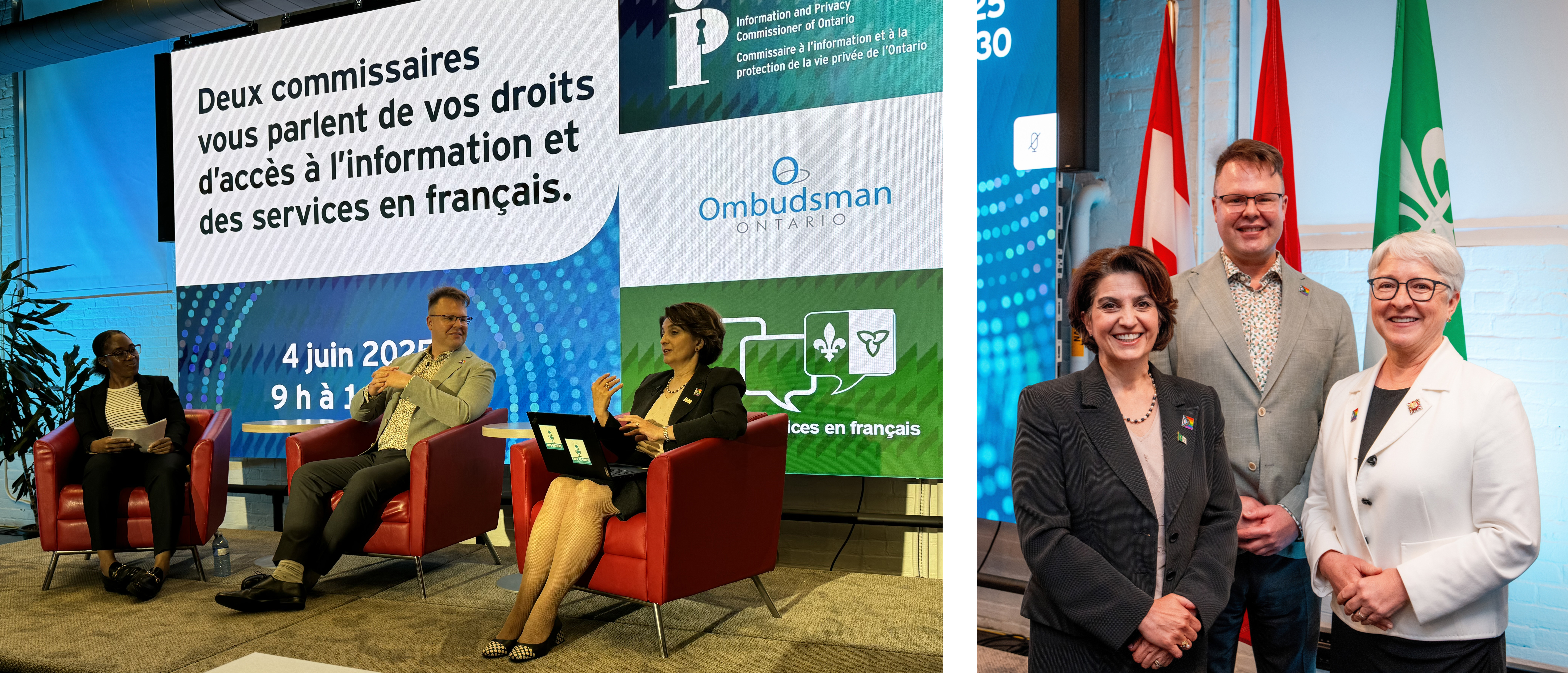
On September 25, 2025, Commissioner Bouchard attended the celebrations of the 50th anniversary of the Franco-Ontarian flag, first at Laurentian University and then at the University of Sudbury, the historic site where the green-and-white flag of Ontario’s Francophonie was raised for the first time in 1975.
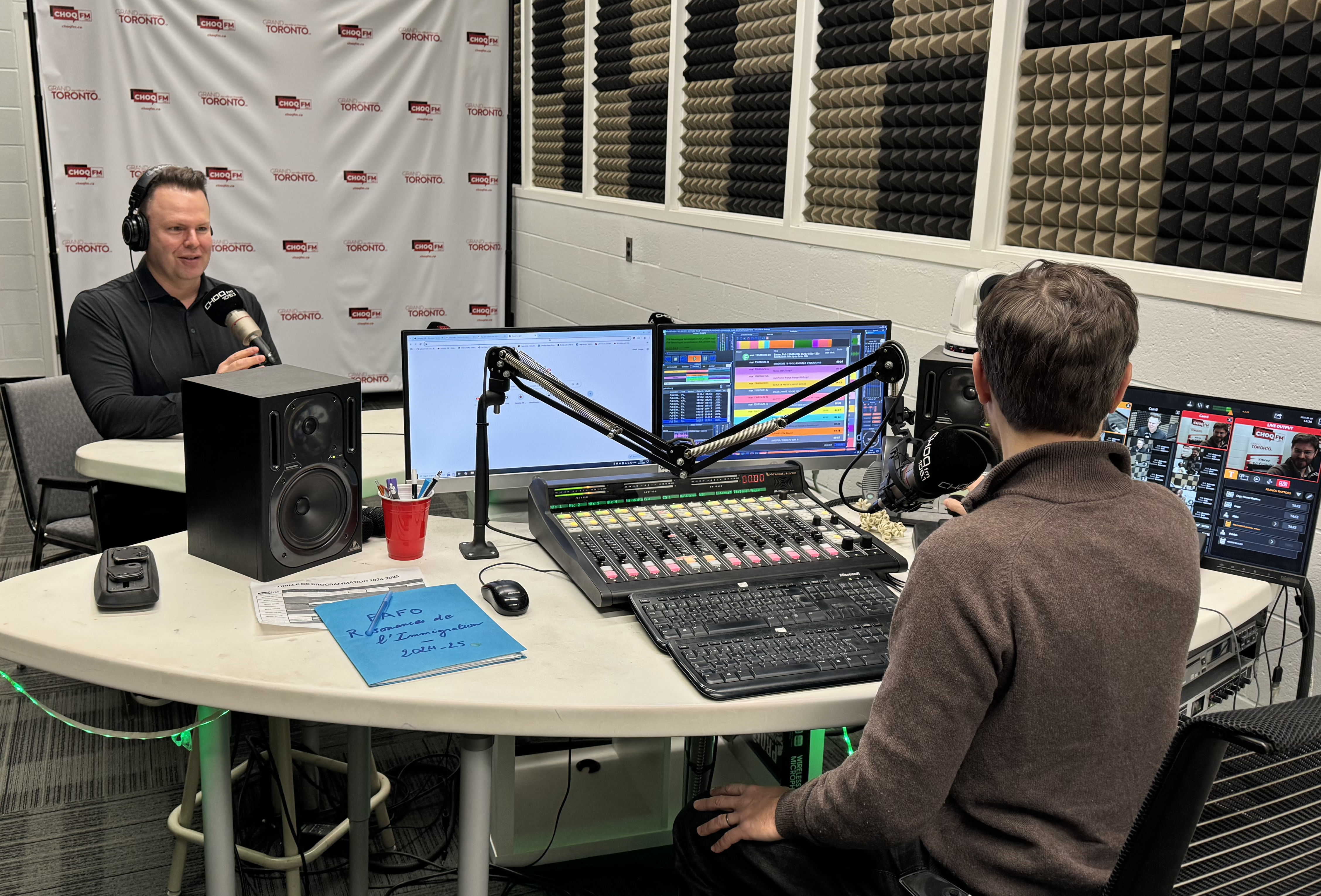
We reached thousands of people through these meetings and events. The Commissioner posted 12 messages on social media, gave 15 media interviews, and answered 9 questions from journalists by email. He also sent 9 letters of congratulations to individuals for their outstanding achievements. The French Language Services Unit also created and shared 3 new videos.
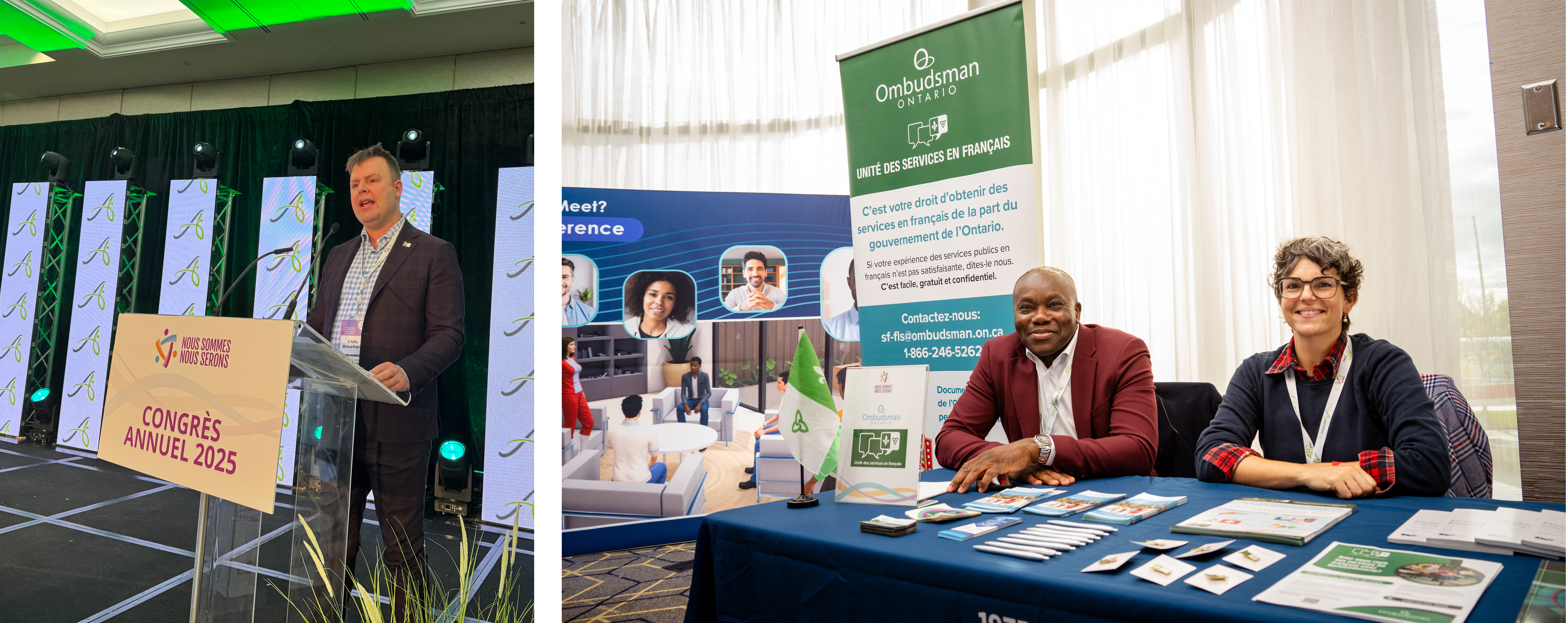
October 23, 2025: Members of the French Language Services Unit working at a booth at the 2025 annual conference of the Assemblée de la francophonie de l’Ontario, Richmond Hill (right).
Members of the French Language Services Unit were also present in the community, staffing 10 booths at various events in the past year. These opportunities allowed them to distribute brochures and materials to the public, answer questions and interact directly with people. These included the AFO annual convention, the Toronto Book Fair, the Vaughan Francophone Fair, the Active Living Fair, and Toronto celebrations of Bastille Day.
By visiting and engaging with Francophones in Northern, Eastern, Central and Southwestern Ontario, the Commissioner and the French Language Services Unit were able to ensure their activities reflected the diversity of the Franco-Ontarian experience. A full list of our engagements between October 1, 2024 and September 30, 2025 can be found in the Appendix.

2024-2025 Highlights
Complaints and inquiries received
- October 1, 2024 – September 30, 2025: 315 cases
Top case topics
- 40.0% IN-PERSON SERVICES
- 18.8% WRITTEN COMMUNICATIONS
- 10.8% ONLINE SERVICES
- 9.2% SIGNAGE
- 7.7% TELEPHONE SERVICES
- 3.8% SOCIAL MEDIA
- 9.7% OTHER
Disposition of closed cases
- 84.8% ORGANIZATIONS SUBJECT TO THE FRENCH LANGUAGE SERVICES ACT (FLSA)*
- 7.9% PROVINCIAL PUBLIC SECTOR NOT SUBJECT TO THE FLSA**
- 5.5% FEDERAL, PRIVATE, OUTSIDE ONTARIO
- 1.8% INFORMATION SUBMISSIONS
*Complaints and inquiries regarding ministries, boards, commissions, corporations and agencies designated under the French Language Services Act (FLSA).
**E.g., municipalities, school boards and agencies not designated under the FLSA.
Disposition of cases closed under the French Language Services Act (FLSA)
- 47.5% RESOLVED WITH OUR OFFICE’S INTERVENTION
- 23.0% BEST PRACTICES SHARED
- 12.4% INQUIRIES MADE OR REFERRAL GIVEN
- 5.6% UNABLE TO CONTACT COMPLAINANT
- 5.1% CLOSED AFTER OUR OFFICE’S REVIEW
- 4.2% RESOLVED WITHOUT OUR OFFICE’S INTERVENTION
- 2.2% WITHDRAWN BY COMPLAINANT
Top organizations (subject to the FLSA) by case volume
- 14.6% MINISTRY OF PUBLIC AND BUSINESS SERVICE DELIVERY AND PROCUREMENT
- 9.6% ELECTIONS ONTARIO
- 9.2% MINISTRY OF TRANSPORTATION
- 7.7% MINISTRY OF THE SOLICITOR GENERAL
- 7.7% MINISTRY OF HEALTH
- 5.8% MINISTRY OF THE ATTORNEY GENERAL
- 5.4% ONTARIO HEALTH
- 3.8% METROLINX
- 3.8% MINISTRY OF CHILDREN, COMMUNITY AND SOCIAL SERVICES
- 14.2% OTHER MINISTRIES*
- 7.7% DESIGNATED AGENCIES*
- 8.5% OTHER BOARDS, COMMISSIONS & CORPORATIONS*
- 2.0% OTHER INSTITUTIONS OF THE LEGISLATURE*
*See the Appendix of this report for a breakdown of these cases.
Communications and outreach
- 23 Events attended
- 56 Meetings and discussions with Franco-Ontarian interest groups and community organizations
- 24 Media interviews and responses to written media inquiries
- 15 Videos and signed social media messages
- 18 Speeches delivered and staff present at 10 booths at conferences and events
Overview 2024-2025
Summary
The French Language Services Unit received 315 cases (complaints and inquiries) between October 1, 2024, and September 30, 2025.
In addition to complaints received about French language services between April 1, 2024, and March 31, 2025 (the period covered by the Ombudsman’s Annual Report) we also handled 348 complaints and inquiries in French about general matters related to provincial and broader public sector administration. This demonstrates that we not only help Francophones with their French language services needs, but that Ombudsman Ontario serves as a single point of entry to a wide range of services to which Francophones are entitled.
This year, the most common cases brought to our attention were those related to in-person services (40% of all cases received involving agencies subject to the French Language Services Act) and written communications (18.8%).
The three areas that received the highest number of complaints were:
Ministry of Public and Business Service Delivery and Procurement (14.6%). Almost all of these cases involved ServiceOntario.
- Elections Ontario (9.6%).
- Ministry of Transportation (9.2%). Almost half of these cases involved road signs.
Since 2019, our Office has received many ServiceOntario cases each year. It is this recurring trend that led the Commissioner to launch an investigation in April 2025, which specifically addresses the delivery of frontline service in French at ServiceOntario locations (see more under Investigation Updates).
Voting in French
At the end of the February 2025 provincial election, some Francophones contacted us to inform us about the lack of French language services in the voting process. Most of the cases were about a lack of in-person service in French at polling stations, due to a lack of French-speaking staff and a failure to provide the “active offer” of service in French required under the French Language Services Act.
We raised these issues with Elections Ontario, which told us that the calling of an early, winter election had a significant impact on its planning in general, including French language services, particularly with regard to the recruitment and training of bilingual staff at the polls.
Elections Ontario committed to continuing to improve its planning for exceptional situations such as early elections, including its ability to recruit and train staff who provide services at the polls.
Fire Code – finally in French
In 2021, a principal in a French-language school board contacted us after trying to obtain the French version of the Fire Code to find out what provisions apply to school facilities. However, the code, which is a provincial regulation, was only available in English. Under the French Language Services Act, it is up to the Attorney General to determine whether it is appropriate to translate a regulation.
We raised the issue with the Office of the Fire Marshal of Ontario, which reports to the Ministry of the Solicitor General. Following our intervention, the Fire Marshal committed to beginning the translation of the regulation in 2023.
We continued to conduct regular follow-ups, and in June 2025, the Office of the Fire Marshal informed us that it had completed the update and translation of the Fire Code. The revised code will be available in English and French when it comes into force in January 2026.
Designation of daycares
In February 2024, Le Petit Chaperon Rouge, a French-language daycare in Toronto, announced the closure of one of its centres. This facility is a designated government agency under the FLSA. We quickly approached the organization and the government to obtain more information about the daycare’s compliance with the Act. At the time, we also received complaints regarding the potential closure. Two weeks after the announcement, the agency reversed its decision, and the site did not close.
Our analysis of these complaints revealed that the list of nearly 40 designated daycare centres in Ontario Regulation 398/93 (see table below) does not reflect reality. This means the public does not have access to reliable information about where they can obtain services in French. We also found that the designated daycare centres themselves were not aware of their legal obligations under the FLSA.
In May 2024, the Commissioner reminded the Ministry of Education and the Ministry of Francophone Affairs of the obligations imposed by the FLSA with respect to the compliance of designated bodies.
He also urged ministries to act quickly to rectify the situation, and to ensure that the corrective measures do not reduce the level of French language services currently offered in Ontario.
We continue to follow up regularly with the ministries to receive progress updates.
Designated public service daycare agencies as per O. Reg. 398/93.
This list reflects the information provided by O. Reg. 398/93. Our Office is aware that some information included in the regulation may not be up to date.
- « Au Ballon Rouge » (Garderie des Petits) in Ottawa
- ACFO Rive-Nord Inc. (Garderie Petit Trésor) in Elliot Lake
- Andrew Fleck Child Care Services
- Cambrian College (l’Arc-en-ciel and le Carrousel) in Sudbury
- Centre de jour des Petits Poucets
- Centre de la Jeunesse de Toronto/La maison Montessori
- Centre des petits d’Ottawa Inc.
- Centre Éducatif Soleil des Petits
- Centre parascolaire «La Clémentine» d’Ottawa
- Centre parascolaire des Pionniers in Orléans
- Centre Passage Parallèle des ressources familiales du Nipissing Inc.
- Centre Pivot du Triangle magique de Rayside-Balfour
- Centre pour enfants Timiskaming Child Care (garde d’enfants en milieu familial)
- Centre préscolaire Coccinelle d’Orléans
- City View Centre for Child & Family Services (Early Years Centre Nepean-Carleton)
- Coopérative Brin d’herbe Inc. in Ottawa
- West Nipissing Child Care Corporation
- Garderie « Sur un nuage » d’Ottawa-Carleton
- Garderie Arc-en-ciel des Mousses Inc.
- Garderie Brin de Soleil d’Ottawa Est Inc.
- Garderie Francophone de St-Catharines Inc.
- Garderie La Farandole de Toronto
- Garderie La Joie de North York Inc.
- Garderie Le Cerf-volant de Gaston Vincent in Ottawa
- Garderie Rayon de Soleil de North York Inc.
- La Boîte à soleil co-opérative Inc.
- La Garderie des Petits Poussins de Port Colborne Inc.
- La Garderie Française de Hamilton Co-opérative Inc.
- La Garderie Le Petit Navire de Hamilton Co-opérative Inc.
- La Garderie Touche-à-tout de Sudbury
- La Petite Étoile de Niagara Inc.
- La ribambelle, centre préscolaire francophone de London
- Le Centre parascolaire l’Hirondelle d’Ottawa
- Le Petit Chaperon Rouge : Garderie Francophone
- Les Bouts d’Choux
- Les Compagnons des Francs-Loisirs (Garderie Soleil) in North Bay
Throughout this report, we highlight many examples of case resolutions that have helped improve respect for French language rights in Ontario. We recount experiences brought to our attention where the delivery of French language services was not satisfactory in key areas such as the administration of justice, active offer, road signs, websites, and French-language characters (e.g., ç, è, é, ê, ë) in names on official documents.
Note: To protect the confidentiality of complainants, the data presented is anonymous. Identifying details, including gender, may have been removed or changed.
Trends in cases: Justice in French
Access to justice in French is fundamental for Ontario’s Francophones.
Our Office does not have jurisdiction over judges or the functions of a court. However, we can look at how the Ministry of the Attorney General administers court services. Once again this year, several Franco-Ontarians contacted us to share their difficulties in accessing justice in French.
For many, it is not only about receiving legal services in their own language, but also about understanding, participating and asserting their rights fairly in the court system.
In previous years, we have drawn attention to issues with the delivery of service in French by the 12 tribunals that make up Tribunals Ontario. (A lack of French-speaking adjudicators at one of these, the Landlord and Tenant Board, was highlighted in the Ombudsman’s 2023 report on delays at that tribunal, Administrative Justice Delayed, Fairness Denied.)
In November 2025, Tribunals Ontario shared its recent progress with the Commissioner. Its Executive Chair reported that thanks to its efforts to train and recruit French-speaking adjudicators, it was able to handle 1,029 proceedings in French in 2024-2025 – 282 more than the previous year. Tribunals Ontario also estimates that nearly 10% of its adjudicators now speak French.
“Tribunals Ontario remains committed to providing [French language services] that are actively offered and of equal quality to services offered in English. Throughout the past year, we have continued to prioritize this obligation and treat it with the utmost seriousness.”
— Letter to Commissioner Bouchard from Sean Weir, Executive Chair, Tribunals Ontario
As the following cases demonstrate, Francophones sometimes have to insist on exercising their right to French language services, which can lead to delays or additional barriers.
Legal obligation
A Francophone immigrant contacted us after going to a provincial courthouse located in an area designated under the French Language Services Act (i.e., where services in French must be provided) for a family law matter. The woman said she was unable to obtain services in French at the court counter. She told us that she “gets by in English,” but the legal vocabulary is far beyond her and her comprehension is diminished. Courthouse staff told her the only French-speaking worker at the counter was absent that day. The woman decided to return home and go to the courthouse another day.
Result
We brought the situation to the attention of the courthouse management and the Ministry of the Attorney General. Since then, the courthouse has recruited five French-speaking people and ensures that there is always more than one French speaker at the counter.
It has also ensured that all courthouse staff are aware of their obligation to ensure an active offer of services in French, as well as the procedure for doing so.
In addition, Ministry officials told us that all courthouse staff have a list of bilingual employees and are instructed to contact them if anyone wishes to be served in French.
They said French language services are a regular topic at regional leaders’ team meetings.
The woman thanked us for our intervention: “I very much appreciate doing business with your Office.”
Email equality
A Francophone woman told us she received a bilingual form in the mail advising her she would be part of a jury selection process, but the email address on the French form was in English only ([email protected]).
Result
We raised the matter with the Ministry of the Attorney General. Following our discussions, it created a bilingual email address ([email protected]) that is now used for jury screening forms. The Ministry also confirmed that correspondence in French received at this email address will be responded to in French.
The right language
A Francophone complained to us about his dealings with the Human Rights Tribunal of Ontario. He said the responses he received regarding his various files with the tribunal were sometimes in French, sometimes in English.
Result
The tribunal told us it has procedures in place to provide services in French and it reminded staff to follow them. It also confirmed this man’s language preference and assigned a French-speaking person to his case. He will receive all future correspondence from the tribunal in French.
Trends in cases: Road signs
We are regularly contacted about signage on provincial roads and highways in Ontario.
Signage in French is important, as those who contact us attest. French signage on the roads helps keep all Ontarians safe, by allowing French-speaking drivers to better understand traffic rules, warnings and directions.
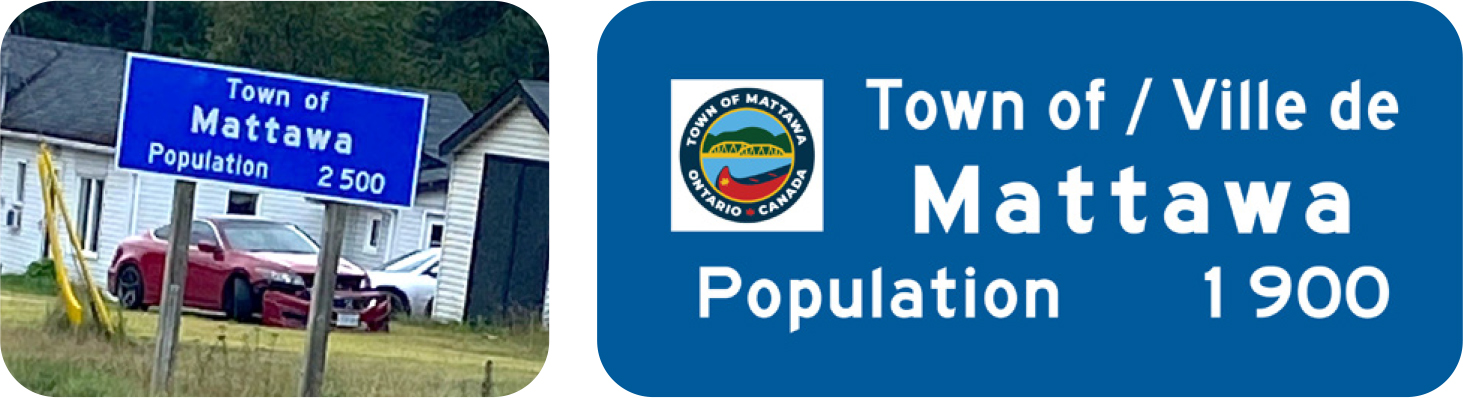
On the road to Mattawa
A man told us he noticed an English-only road sign for the Town of Mattawa on Provincial Road 17, at the western edge of the municipality. This town, located in the northeastern part of the province, is part of the District of Nipissing, which is a designated area under the French Language Services Act. This means all services of the Government of Ontario and its offices located in or serving Mattawa must be actively offered in French.
Result
We pointed out the sign to the Ministry of Transportation, which committed to replacing it with a bilingual version.
Down cemetery road
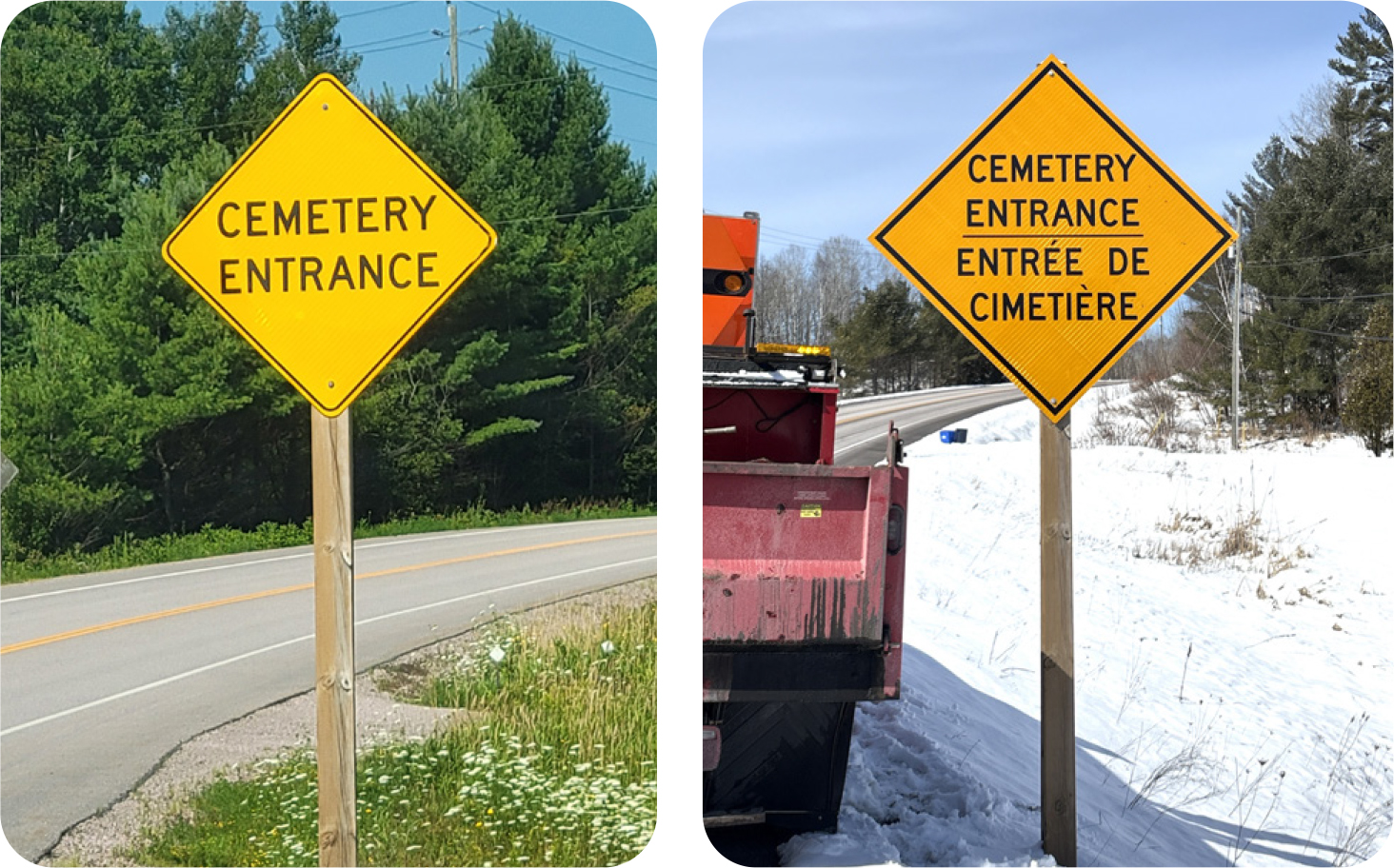
A man contacted us about an English-only road sign at the entrance to a cemetery on Provincial Route 64 in Alban in the Sudbury District, an area designated under the FLSA. He told us that he did not understand “why the Ministry puts up signs in English only in a designated area.”
Result
After our intervention, the Ministry confirmed that a new bilingual sign had been installed at the entrance to the cemetery.
The man thanked us for our work: “I’m happy that the situation has been rectified.”
A warmer welcome
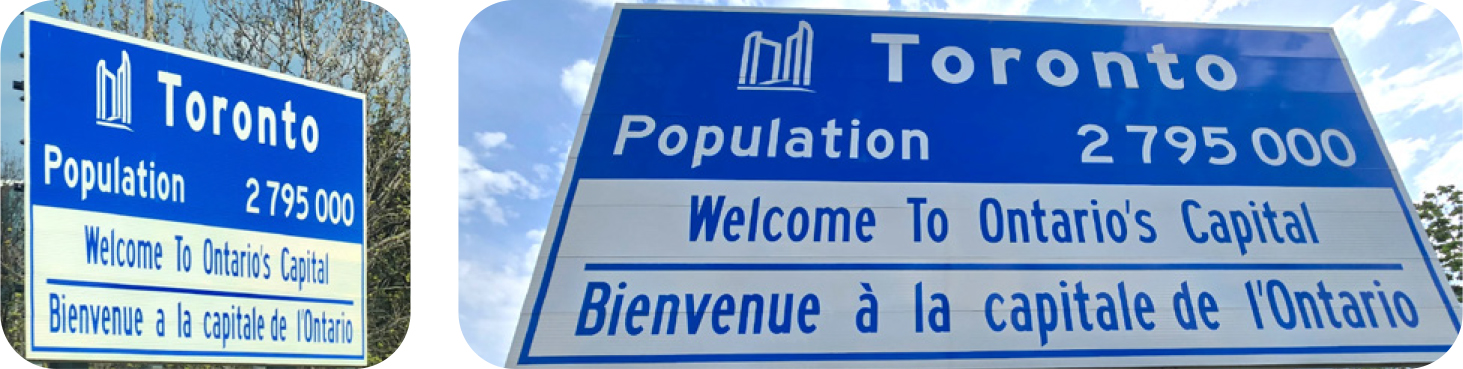
We noticed that an accent was missing in the French version of the “Welcome to Toronto” (Bienvenue à Toronto) sign on Highway 401 at the western boundary of the city, which is located in an area designated under the FLSA.
Result
After we alerted the Ministry of Transportation about the error, it quickly corrected the sign.
Constructive change
We noticed that signs installed by Metrolinx around the Scarborough subway extension construction site were in English only. Scarborough is a neighbourhood in Toronto that is a designated area under the French Language Services Act. Metrolinx, as a government agency, must therefore provide its communications in English and French, including signage.
Result
We raised the issue with Metrolinx officials, who told us that these signs had been in place for more than three years and that it had since changed its practices. As a result of our intervention, Metrolinx acknowledged that signs on construction sites must be bilingual and replaced the unilingual signs with bilingual signs. It also installed additional bilingual signage near the site for the same project.

Trends in cases: Unequal websites
The websites of the Ontario government, its agencies, its third parties and government agencies designated under the French Language Services Act must be accessible in French.
For many Franco-Ontarians, websites are often their main source of information about these agencies. But they regularly encounter French versions of sites that are poorly translated from English, or that lack some of the content or updates available in the English versions. Technical issues, such as broken links or partially translated pages, also affect their user experience.
These shortcomings often force Francophones to toggle back and forth between French and English web pages, or even to give up on seeking information in French. This lack of coherence and rigour in the digital offer of service in French compromises the respect for language rights in Ontario.
Below are some examples of how we have dealt with this issue:
Ready in both languages
While looking at a social media post about the Practice Ready Ontario medical program, a Francophone noticed that the web page with information about this program, which assesses internationally trained physicians’ qualifications to practice in Ontario, was entirely in English. He told us: “It’s a bit weird that everything is in English.”
Result
We raised the issue with the Ministry of Health. Initially, it indicated that the program was a pilot project and a French version would only be created in a few years, once the program was fully implemented. As a result of our discussions, the Ministry determined that publicly available information about the program should be available in French on the current web page.
Lost translation
After losing an item on a GO Transit bus, a Francophone woman went to GO Transit’s website, only to discover that the lost item report form was in English only. She told us she reached out to us after she tried unsuccessfully to receive help in French from Metrolinx, which operates GO Transit.
Result
We raised the case with Metrolinx officials, who committed to updating all French and English forms on its website, as well as redesigning the “Lost and Found” area to improve the overall experience, accessibility and compliance with the French Language Services Act. While this work is ongoing, Metrolinx has implemented a temporary solution where a French-speaking officer is available by phone to complete and submit the form on behalf of Francophones.
We continue to monitor Metrolinx’s progress in redesigning its website to ensure compliance with the FLSA. The woman told us: “I appreciate the work done, this resolution is perfect.”
Personalized, not in person
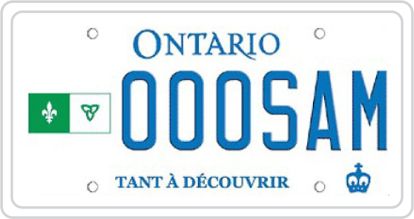
A Northern Ontario man wanted to apply online for a personalized licence plate for his vehicle with a graphic and slogan in French. On ServiceOntario’s French website, it indicated that this service was only available in person at a ServiceOntario location. However, the English version of the same page said a personalized plate with a graphic and slogan in English could be ordered online. The man noted that the service in French was therefore not equivalent to that in English.
Result
We contacted ServiceOntario, which quickly began taking steps to update its system so that personalized French plates could be ordered online in French. As of August 2025, it is now possible to order a personalized plaque with a graphic and a slogan in French online.
The man told us: “I am delighted to know that this is settled. Thank you for following up.”
Links to nowhere
A Francophone man sought our help after he went to the French version of the Health Professions Appeal and Review Board (HPARB) website to look for information. He discovered that several links were not working and instead displayed this English-only error message: “The resource you are looking for has been removed, had its name changed, or is temporarily unavailable.”
We visited the website and found several other links that displayed the same message, preventing Francophones from accessing information equivalent to that available on the English version of the board’s website.
Result
We raised the issue with the Ministry of Health, which oversees the HPARB. As a result of our intervention, the problems identified on the French version of the HPARB’s website were resolved.
Inconsistencies permitted
A man told us he visited the French version of the Ontario Parks website and found that the information regarding seasonal day-use permits said, only in English: “Annual Vehicle Permit, Summer Vehicle Permit and Winter Vehicle Permit.”
He also observed several other inconsistencies on the French site. For example, the link for relevant legislation pointed only to an English version, even though an equivalent French version of the same legislation does exist, which could have been linked instead.
Result
After we spoke with Ontario Parks, it conducted a full audit of its website and corrected all the errors the man had raised. It also committed to reviewing its website regularly to optimize the quality of its French-language content.
Trends in cases: French accents on names
Francophones often face additional steps to have the spelling of their names corrected on official documents or to report errors.
The lack of French language characters (e.g., ç, è, é, ê, ë – also known as diacritical marks) in names on official documents has been raised multiple times over the years by those affected. Our efforts to bring the matter to the attention of the Ministry of Transportation and Ministry of Health contributed to the marks being added to driver’s licences and Ontario photo ID cards in 2020 and health cards in 2022.
However, technical and administrative challenges persist, and some government IT systems are not yet fully compatible with French language characters. Sometimes the accented letters are omitted or replaced, which can create inconsistency in an individual’s official documents.
For example, vehicle registration certificates (the green paper card that is issued with vehicle licence plates) still cannot be printed with diacritical marks. That is why we have continued to follow up on this issue.
The Ministry of Transportation has told us it is working on a multi-year project to modernize its various systems. It anticipates that more than 600 documents/products will be able to include French language characters (and other diacritical marks) by the end of the 2027-2028 fiscal year. About 40 of these are documents provided to the public through ServiceOntario, DriveTest Centres or directly from the Ministry. We will follow up on the progress of this project in future annual reports.
Coöperation leads to correction
A French-speaking mother contacted us after discovering that her 3-month-old daughter’s health card contained a mistake. It was missing two dots over a letter in the girl’s first name (a diacritical mark called a diaeresis, or “tréma” in French, as in “Noël”). She stressed that all the information had been completed correctly at the hospital where the child was born, and the province had issued a birth certificate with the diaeresis. She questioned at which level the health card error had occurred.
“It’s really unfortunate, because I have a 3-month-old baby, but I have to go to a ServiceOntario office in person to ask for the change, and I don’t really have time to do that,” she told us. “I have to take this extra step to have the tréma added.” [Translation]
Result
We raised the issue with the Ministry of Public and Business Service Delivery and Procurement. We learned that when a child is born in an Ontario hospital, the parents are asked to complete a form to enrol the baby in the Ontario Health Insurance Plan (OHIP). The form goes to ServiceOntario, which issues the health card. The Ministry indicated that handwriting is sometimes difficult to read, which may explain the error.
We received confirmation from the Ministry that the correction was made without the mother having to go back to a ServiceOntario office. She was relieved to receive a new card with the requested correction.
Accent on attention
A Francophone mother contacted us after she tried to add an acute accent (é) to her daughter’s name when renewing her health card online through the ServiceOntario website. She said the girl’s first card was issued without the accent, which she believed was due to an error in the forms that were filled out at the hospital when the child was born.
Result
We raised the case with officials at the Ministry of Public and Business Service Delivery and Procurement, who noticed that the child’s birth certificate contained the accent on the first name. They located the hospital form and confirmed that the accent was on the form – but had apparently been missed when the information was manually added into its database.
The health card was changed without the mother having to go to a ServiceOntario location. Staff were also reminded to pay particular attention to accents during data entry. After receiving her daughter’s new health card with the accent in her first name, the woman thanked us for our work.
Read the fine print
After receiving his new driver’s licence, a Francophone man noticed that the letter “é” in his first name did not appear correctly in the microtext security feature – the line of tiny text that appears to the left of the photo and on the back of the card. The accented letter had been replaced with a square. He was concerned that the legitimacy of his licence would be questioned if he were to be subjected to an identity check in another province or abroad.
Result
We raised this issue with the Ministry of Transportation, which contacted the supplier responsible for printing driver’s licences. We were told the issue was due to the font used. The Ministry confirmed the man’s licence was legitimate and conformed to North American standards for police and government authorities.
Nevertheless, the Ministry told us its supplier conducted a series of tests of French accents and other diacritical characters and corrected this microtext issue. In light of this case, we were told the Ministry tightened its control processes. A new driver’s licence was issued and sent to the driver.
Issues related to the application of the FLSA
The rights of Ontarians to obtain services in French are defined in the French Language Services Act and its Schedule (which lists designated areas), as well as five regulations:
- A regulation that lists designated agencies (398/93)
- A regulation that allows the government to designate additional areas (407/94)
- A regulation on active offer (544/22)
- A regulation on the obligations of third parties providing services on the government’s behalf (284/11)
- A regulation on exempting agencies from their obligation to provide French translations of their publications (671/92)
One of our roles, under the FLSA, is to advise the Minister of Francophone Affairs on matters related to its application. The cases we have dealt with since May 1, 2019 have led us to examine all of these legislative and regulatory tools.
List of designated areas: Our proposal for better updates
In December 2024, the Ministry of Francophone Affairs sought feedback on its proposal to amend the list of designated areas under the French Language Services Act.
The Ministry’s proposal was aimed at increasing French language services in Ontario. In January 2025, Commissioner Bouchard made a submission recognizing the important and necessary work undertaken by the Ministry to update the designated areas to reflect the evolution of their geographic boundaries over the years.
The submission (available on our website under “Our Work/Submissions to Government”) noted that the Commissioner is encouraged by the government’s efforts to update the list of designated areas, but pointed out three changes that were not reflected in the proposed amendments to the Schedule:
- The Town of Belle River, and the Townships of Maidstone, Tilbury North and Tilbury West should be removed and replaced by the Municipality of Lakeshore, which they are now part of.
- The Township of Sandwich South should be removed, as it is now part of the already designated Town of Tecumseh and the City of Windsor.
- The Township of Sandwich West should be removed and replaced by the City of LaSalle, which it is now part of.
We made four proposals to ensure that the list of designated areas is properly updated:
- The Ministry should consult the Ministry of Municipal Affairs and Housing to ensure that the review of the Schedule to the French Language Services Act is comprehensive and provides an exhaustive update of the list of designated areas that is consistent with the current names and borders of municipalities.
- The Ministry should coordinate the development of a government-wide strategy to ensure that French language services covered by the FLSA are available in all designated areas.
- The Ministry should provide updates in its annual reports on the overall progress made implementing these changes. All ministries affected by these changes should provide updates on their progress to the Ministry of Francophone Affairs and in their reports to the Executive Council, as outlined in section 12.0.1 of the French Language Services Act.
- The Ministry should take the opportunity to update public information not only on designated areas, but also on government agencies designated under O. Reg. 398/93, and – as the Commissioner recommended in his 2023-2024 Annual Report – create a comprehensive digital tool that would help the public clearly identify where government services covered by the FLSA are available.
At the time of writing this report, the Ministry hoped to complete regulatory and legislative work related to the expansion and updating of several designated regions by the end of March 2026.
Designation of public service agencies (Regulation 398/93): Revisions due in 2026
In our 2021-2022 Annual Report, we recommended that the Ministry of Francophone Affairs develop a plan to update Ontario Regulation 398/93, which lists designated agencies that are required to offer some or all of their services in French.
The often-outdated information communicated to the public through this regulation makes it difficult, or even impossible, to assess the French language services obligations of designated agencies.
This lack of rigour in the accuracy of the information communicated to the public is a barrier to access to important French language services, including those related to health, early childhood and post-secondary education, social and community services, and long-term care.
In response to our recommendation, the Ministry of Francophone Affairs established a plan with a timeline to complete the update of the regulation in June 2026.
Between January 2023 and June 2025, the Ministry amended information for 132 of the 256 designated agencies. We are analyzing the changes to understand their nature.
Recently, the Ministry told us it was reviewing its original timeline because of the complexity of some cases. We will continue to follow up regularly until Regulation 398/93 is fully updated.
Active Offer (Regulation 544/22): Legal obligations vs. real-life experience
The “active offer” of French language services is a legal obligation under the FLSA. Regulation 544/22, which came into force in 2023, contains nine “prescribed measures” that government agencies must take to meet this obligation.
“Active offer” means that services must be clearly available in French from the first point of contact, without a person having to ask for them. This includes greetings, signage, documentation, electronic communications, and the provision of oral and written services. Once a person has stated their language preference (English or French), the service should continue in that language. The active offer is essential to ensure equitable access to public services and to respect the linguistic rights of Franco-Ontarians.
To implement the obligations prescribed in the regulation, government agencies have adopted and updated policies and processes, and trained staff in delivering services in French.
However, as the following cases demonstrate, implementation of the prescribed measures is a process that is still ongoing, and some organizations continue to struggle to ensure a real active offer, particularly when it comes to things like their phone systems, signage and various communications.
As long as it takes
A Francophone woman who had recently arrived in Canada contacted us after unsuccessfully trying to apply for Ontario Disability Support Program (ODSP) benefits by phone, in French. We called the ODSP support line ourselves and found that although there was an option to be served in French, callers must listen to an English-only message for two and a half minutes before the French version begins.
Among the nine prescribed measures for ensuring an active offer of service in French in Ontario Regulation 544/22, Measure 2 states: “Any automated telephone systems shall provide persons, at the start of the call, the option of receiving services via telephone in English or French.”
Result
We raised the issue with the Ministry of Children, Community and Social Services, which is responsible for the ODSP. As a result of our intervention, the Ministry committed to updating the recorded messages and testing the telephone system. Callers now have the option to choose service in English or French at the outset.
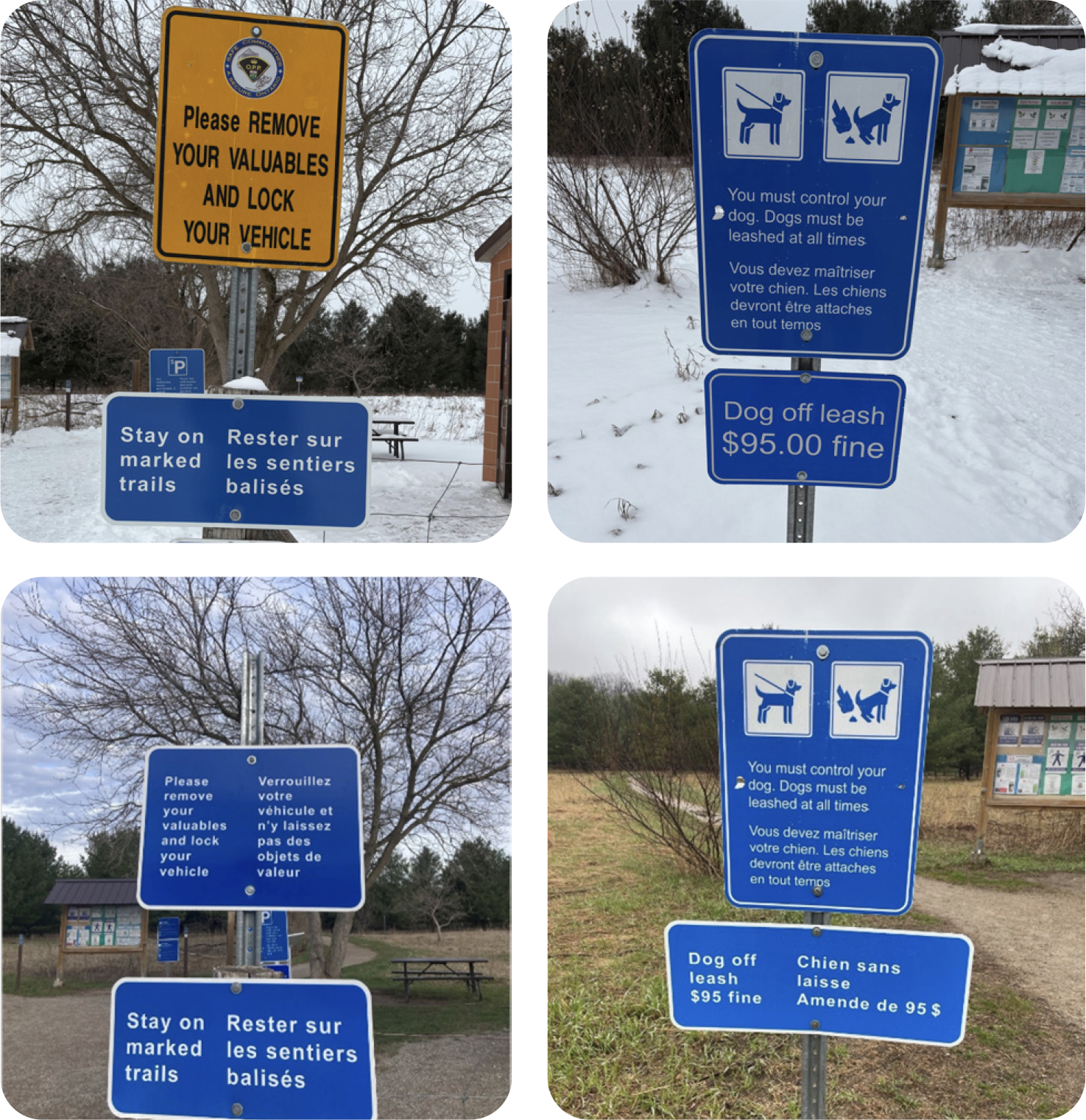
Park parity
During a visit to Komoka Provincial Park near London, Ont., a Francophone man noticed that many of the signs were only in English, while others were bilingual.
Among the nine prescribed measures for ensuring an active offer of service in French in Ontario Regulation 544/22, Measure 5 says that signs identifying an agency’s services “shall include the written text in both English and French in equal prominence,” or “a sign containing the equivalent French text shall be placed next to the sign containing the English text, and both signs must be of equal prominence.”
Result
Our research indicated that the easternmost portion of Komoka Provincial Park adjoins the City of London, which is a designated area under the FLSA. We referred the issue to Ontario Parks, which is part of the Ministry of the Environment, Conservation and Parks. Following our intervention, the Ministry committed to installing bilingual signs throughout the park to avoid confusion for visitors. The man thanked our team for their “great work.”
Sign of respect
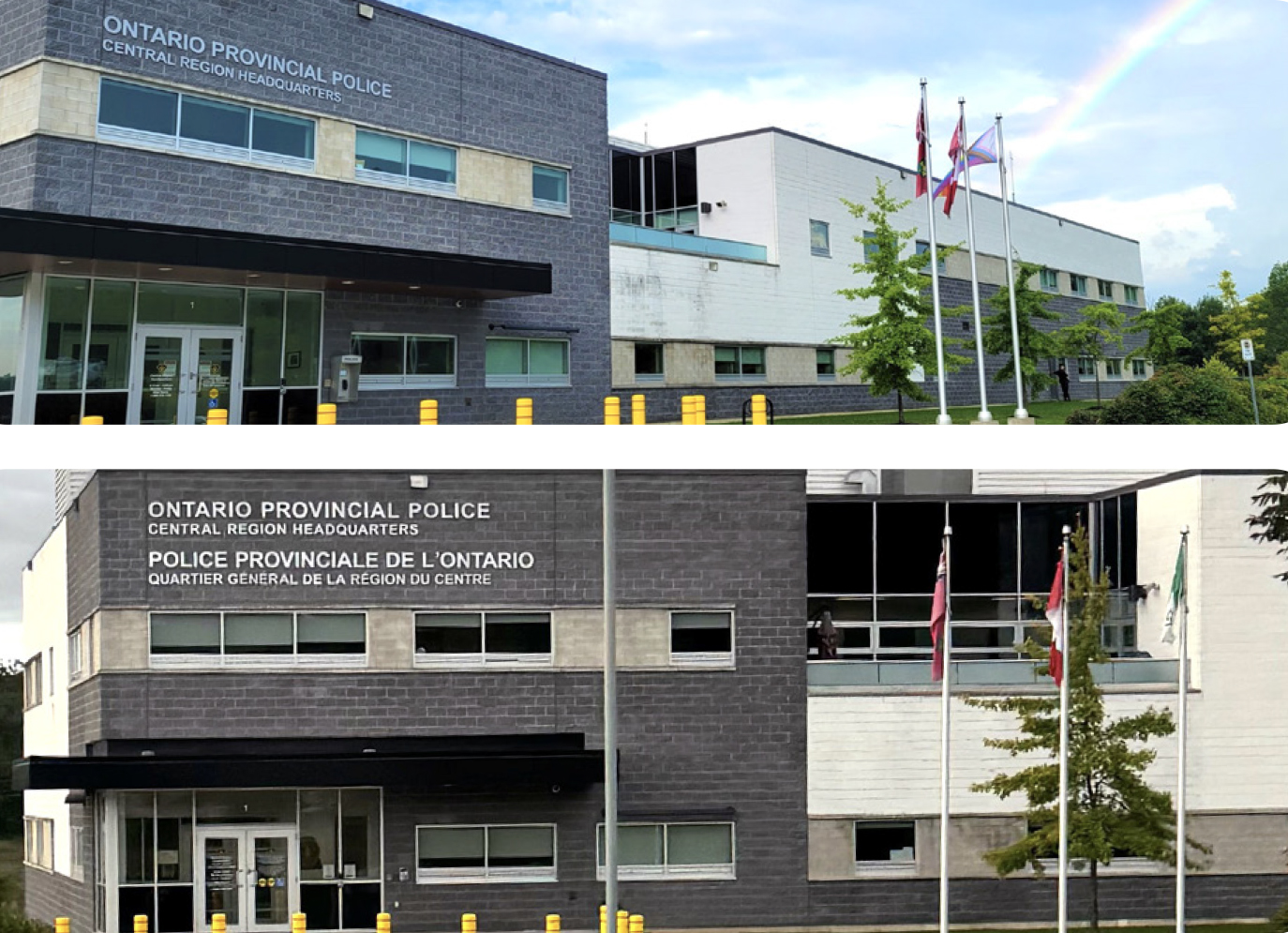
A man contacted us to flag the fact that the signage identifying the Ontario Provincial Police Central Region Headquarters in Orillia was only in English.
Among the nine prescribed measures for ensuring an active offer of service in French in Ontario Regulation 544/22, Measure 5 says that signs identifying an agency’s offices or services “shall include the written text in both English and French in equal prominence.”
Result
We raised the issue with Ontario Provincial Police (OPP) officials, who recognized that, although their head office is not located in a designated region, as an agency of the provincial government, they are subject to the French Language Services Act. The sign on the building was changed, and the OPP also committed to updating other signs, such as those relating to deliveries, visitors and fire routes.
Building bilingually
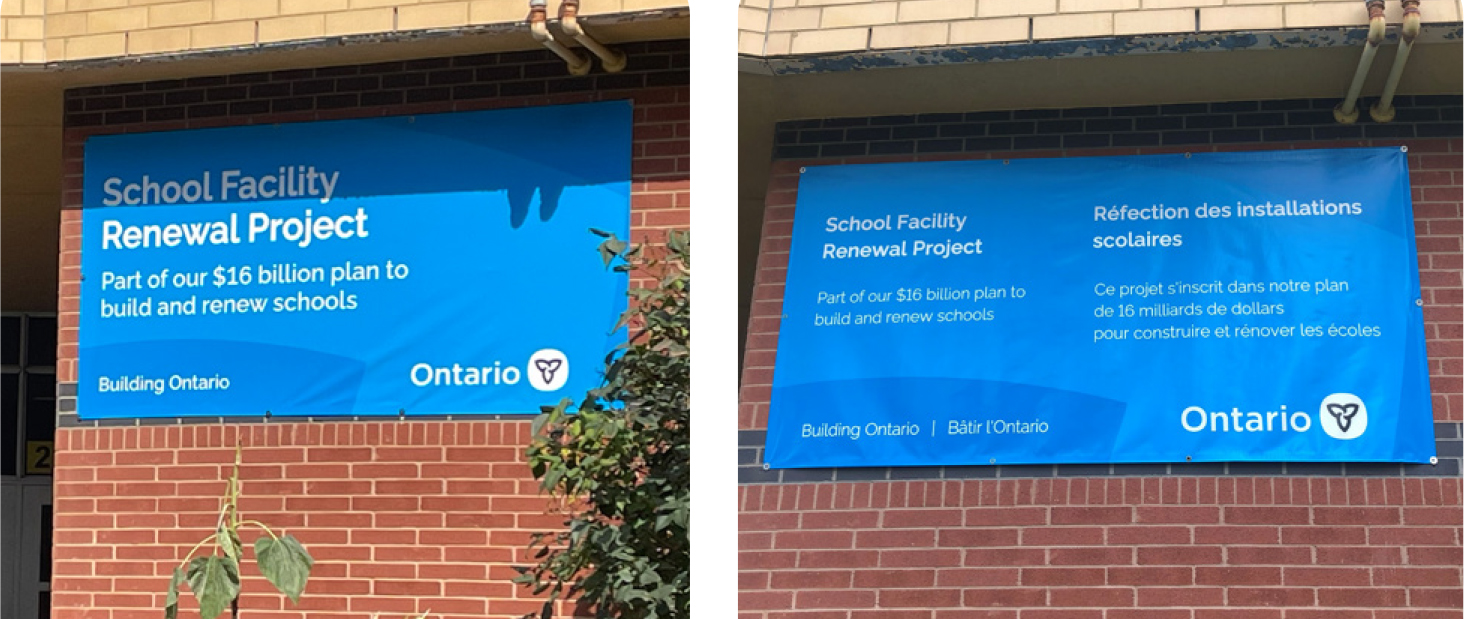
We noticed unilingual “Building Ontario” banners on some schools in an English-language school board in Toronto, an area designated under the FLSA. These banners are intended to raise awareness of provincial government investments in school facilities.
As part of its prescribed measures for ensuring an active offer of service in French in designated areas, Regulation 544/22’s Measure 5 calls for written text about services to be “in both English and French in equal prominence.”
Result
We raised the issue with the Ministry of Education, which confirmed that school boards doing work on buildings in designated areas are required to use bilingual signage. This expectation is set out in a communication protocol provided to school boards. Ministry officials re-shared this protocol with the board in question. The banners were replaced. The Ministry has revised the protocol distributed to all school boards in the province, and added a hyperlink to the map of designated areas.
Seen and heard
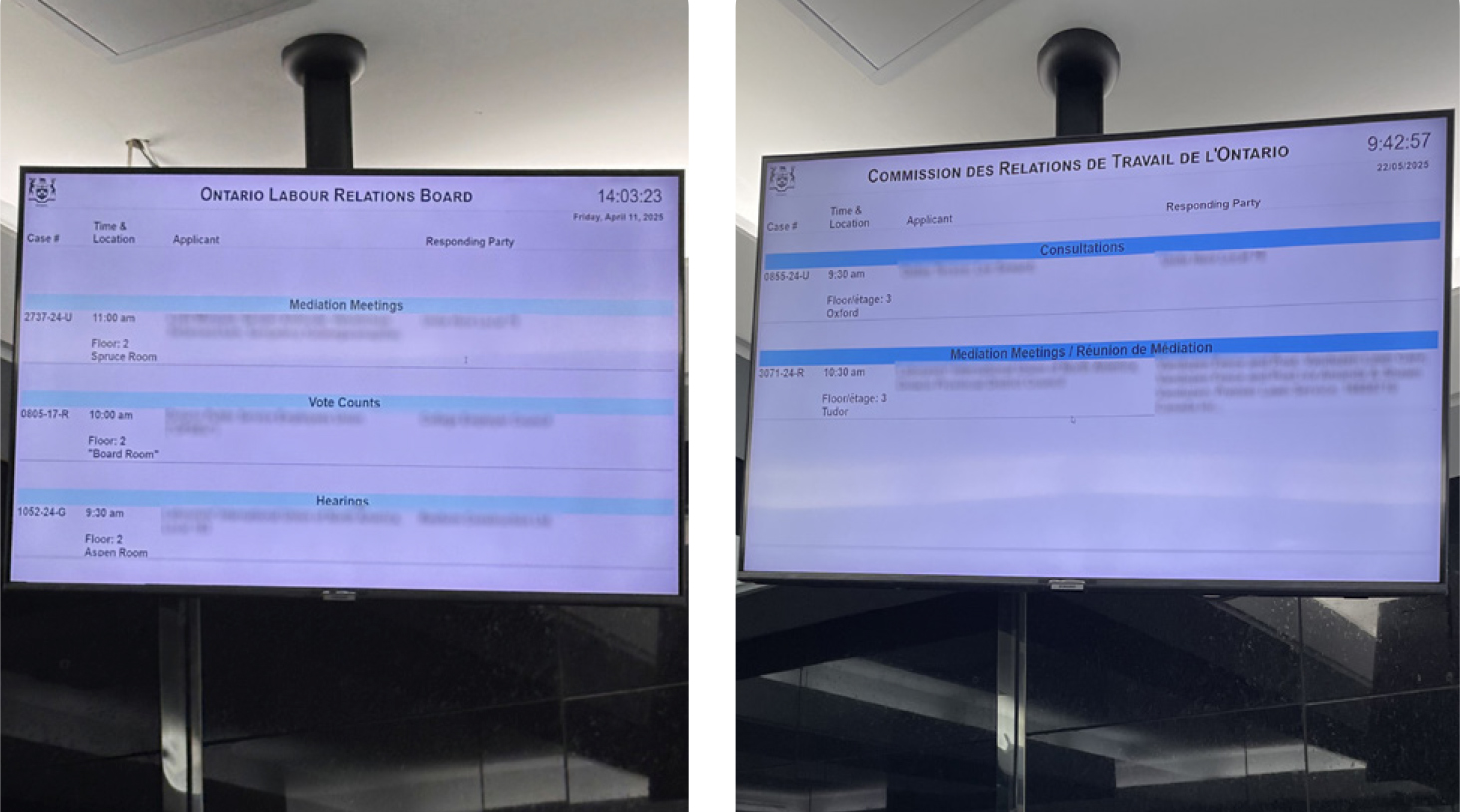
A Francophone woman was at the Ontario Labour Relations Board’s offices in Toronto, where she noticed a screen in the lobby that listed the board’s scheduled hearings that day. As she watched this screen during the 10 minutes she was waiting there, she noticed that the content, including the name of the board, was only in English.
Measure 5 of Ontario Regulation 544/22 states that signs identifying an agency’s services “shall include the written text in both English and French in equal prominence.”
Result
The Labour Relations Board is a government agency subject to the FLSA. Once we reached out to the agency about its lobby screen, its staff quickly rectified the situation and sent us a photo of the screen displaying the hearing schedule alternately in French and English. We informed the woman of this resolution and she thanked us for our work.
Under-the-table service
A Francophone woman attended the Skills Ontario Competition in May 2025. This multi-day event offers students from across the province the opportunity to compete in skilled trades and technologies. Several Ontario ministries had information kiosks at the event, but the woman told us she saw no French materials or bilingual staff at the Ontario Employment Standards booth. She told us the people staffing the booth said information in French was only available online, which she found “insulting.”
Measure 6 of Ontario Regulation 544/22 says if an agency publishes information in English about its services, “a French version containing the same information shall also be provided at the same time and in the same format.”
Result
We raised this case with the Ministry of Labour, Immigration, Training and Skills Development. The Ministry acknowledged that the employees who were present at the booth that day were not bilingual and not aware that French versions of brochures were actually available in a box under the table.
The Ministry committed, as part of an action plan, to guaranteeing the quality of French language services through, among other things, having French-speaking personnel at events and updating internal resources and tools. The Ministry also indicated that it has set up a review team for future events that will review documents in French and ensure this material is available and visible.
Long-term solution
After filing a complaint in French with the Ministry of Long-Term Care about a situation in a long-term care home, a woman received a phone call from an inspector to share information about the inspection that was conducted. The woman told us the inspector began the conversation by acknowledging that she had asked to be served in French. The inspector then apologized for not being able to speak French.
The woman said she was told there were no French-speaking staff on the inspector’s team, and the inspector asked if she would agree to receive the information in English. She told us that since she had been waiting for this call for more than a week, she felt her only option was to agree to listen to the inspector’s report in English, which she did.
Measure 9 of Ontario Regulation 544/22 prescribes that agencies have a process in place to ensure that once someone has requested service in French, they “will continue to be served in French at every step without having to ask for French service again.”
Result
After we raised this case with the Ministry, it informed us that the protocol in such a situation is that when a French-speaking inspector is not available, a French-speaking employee must initiate the phone call in the inspector’s presence. The employee reads the report in French to the Francophone caller, and, if necessary, can act as an interpreter between them and the inspector. The Ministry indicated that the process requires that the employee and inspector arrange a meeting to prepare for the call beforehand.
In this case, the Ministry reminded the inspector of the requirements for an active offer of service in French, and provided her with information, resources and training materials to prevent the situation from happening again. In addition, an email was sent to all staff reminding them to complete “active offer” training, and the Ministry added in-person service in French to the topics discussed at its next staff meeting.
The woman thanked us for our work: “This resolution makes sense. Nice work.”
Your email in French was received
A Francophone woman who was required to report to the Ministry of Transportation’s Medical Review Office about a change in her vision asked if she could submit a request for a review by email. She received a response in French indicating the process to follow, which she did. However, she told us the response from the Ministry confirming receipt of her request was in English only.
Ontario Regulation 544/22’s Measure 9 states that as part of an active offer of service in French, once someone has requested service in French, they should “continue to be served in French at every step without having to ask for French service again.”
Result
We raised the issue with Ministry officials, who told us the English response to the woman’s French email was due to an administrative error in customer service. After identifying the source of this error, the Ministry issued a reminder to staff of the procedures for such requests, and of the consequences that such an administrative error can have.
Translation exemptions (Regulation 671/92): The risks of misinterpretation
In general, all services, including communications, covered by the French Language Services Act must be available in French and actively offered in an equivalent manner to services in English.
The spirit of the FLSA, set out in its preamble, expressly indicates the Legislative Assembly’s aim to safeguard the cultural heritage of the province’s Francophones for future generations, as well as to guarantee the use of the French language in the Government of Ontario.
The language rights guaranteed by the Act are quasi-constitutional in nature. The courts have held that these are to be interpreted broadly and liberally, and may be limited only where reasonable and necessary. Any restriction or exemption on the language rights protected by the FLSA, including those prescribed by regulation, cannot undermine the general purpose of the Act and should be interpreted in a manner consistent with the preservation and development of Ontario’s Francophone communities.
Regulation 671/92, made under the FLSA, allows for certain publications to be exempt from the Act’s translation requirements if they are “of a scientific, technical, reference, research or scholarly nature […] are not normally available for general circulation to members of the public” or “are normally consulted by members of the public with the assistance of public servants.”
However, we have noted in several recent cases that this exception is being inconsistently and often erroneously applied – resulting in significant gaps in French language services and differences between the information provided to the public in French, versus that provided in English.
Some examples:
- Metrolinx held public consultations in Durham Region on a plan to build a rapid-transit bus lane. A 580-page environmental study, in English, was made publicly available as a reference document. After Metrolinx received a complaint from a Francophone who felt disadvantaged in this consultation process, it offered a French version of the 75-page summary, but not the full study.
- Infrastructure Ontario consulted with the general public on the development of a housing construction strategy around Toronto’s new subway stations. Not all of the reference documents available on Infrastructure Ontario’s website for this consultation were available in French. This case was brought to our attention by a French-speaking person who wanted to participate.
- During the COVID-19 pandemic, Public Health Ontario regularly posted information about testing, in English only, on its website. When we asked Public Health Ontario about this practice, we were told that although this information was publicly available on its website, which is accessed by thousands of users, the information itself was intended for laboratory technicians and health care personnel.
We contacted the Ministry of Francophone Affairs, which is responsible for administering the FLSA and its associated regulations, to find out if there were any guidelines to assist government agencies in deciding when to exempt publications from translation requirements.
The Ministry told us that there are currently no guidelines regarding the application of Regulation 671/92. Government agencies themselves assess the appropriateness of applying exemptions.
The Commissioner’s recommendation
The lack of a standardized application of Regulation 671/92 creates practices that are confusing for Francophones, who notice differences between the provision of government services in French and English. This situation also leads to uneven application of the regulation amongst government agencies. Moreover, there is a real risk that overapplication of the exemption, which should be interpreted and applied very narrowly, will lead to infringement of the linguistic rights the FLSA is designed to protect.
There are a number of strategies that agencies could implement to properly handle exemptions for documents that are not intended for the general public – for example, creating members-only sections on websites, or consulting with the Ministry of Francophone Affairs before granting an exemption.
These improvements would help standardize practices and ensure proper interpretation of Regulation 671/92, allowing access only to information intended for the general public, and in an equivalent manner in both French and English.
The Commissioner therefore recommends:
Recommendation
That the Ministry of Francophone Affairs establish a framework with clear parameters to support all organizations subject to the French Language Services Act in the interpretation of Regulation 671/92 in promoting a very limited application of exemptions, and that it provide us with a copy of it.
Investigation updates
Services in French at ServiceOntario locations
Launched: April 2025
The Commissioner launched this investigation on his own initiative to determine the extent to which ServiceOntario complies with the French Language Services Act, including:
- Whether ServiceOntario staff at locations required to provide service in French under the FLSA are aware of their obligations to provide in-person service in French;
- How the FLSA is applied at ServiceOntario locations; and
- The quality of in-person service in French, including whether an active offer is made, bilingual staff are available and their proficiency to provide equivalent service in French.
As part of the ongoing investigation, we are:
- Communicating with members of the public who have contacted us;
- Conducting interviews with staff from ServiceOntario’s private and public offices and with Ministry officials;
- Reviewing documents provided by the Ministry.
We continue to encourage anyone with relevant information about this investigation to contact us. We will present our findings in an investigation report once it is completed.
Unilingual government out-of-home advertising
Report: Missed Messages, July 2024
This investigation revealed that only three of the 17 outdoor advertising campaigns that the Ontario government conducted on health-related topics between April 2020 and March 2023 contained any ads in French, and that none respected the spirit of the French Language Services Act.
The report’s seven recommendations were addressed to Cabinet Office, the Ministry of Francophone Affairs and the Ministry of Health. Five recommendations were accepted and two remain under review, including the recommendation to Cabinet Office that a bilingual format be used for all out-of-home government advertising.
The Ministry of Francophone Affairs indicated that it is engaged in a process to review its directives on communications in French so that they are in line with the measures prescribed in Regulation 544/22 for the active offer of French-language services. It is aiming to have an updated version of the directives and support tools for all government staff related to active offer by fall 2026.
The Ministry of Health also committed to ensuring that its external communications staff are familiar with their obligations regarding communications and advertising in French.
We continue to monitor progress every six months and report on it publicly when appropriate.
Best practices: In the meantime, we also noted some exemplary practices of other public agencies regarding out-of-home advertising in the past year:
- We contacted the Ontario Cannabis Store (OCS) after noticing it was running a campaign consisting of four different digital billboards near the Gardiner Expressway Toronto – all with English-only content. The OCS, which is subject to the French Language Services Act, told us the campaign was running in a dozen cities and would end in a week. We drew the agency’s attention to our Missed Messages report and recommendations. It indicated to us that it will use a bilingual format throughout the province for any future outdoor advertising campaigns.
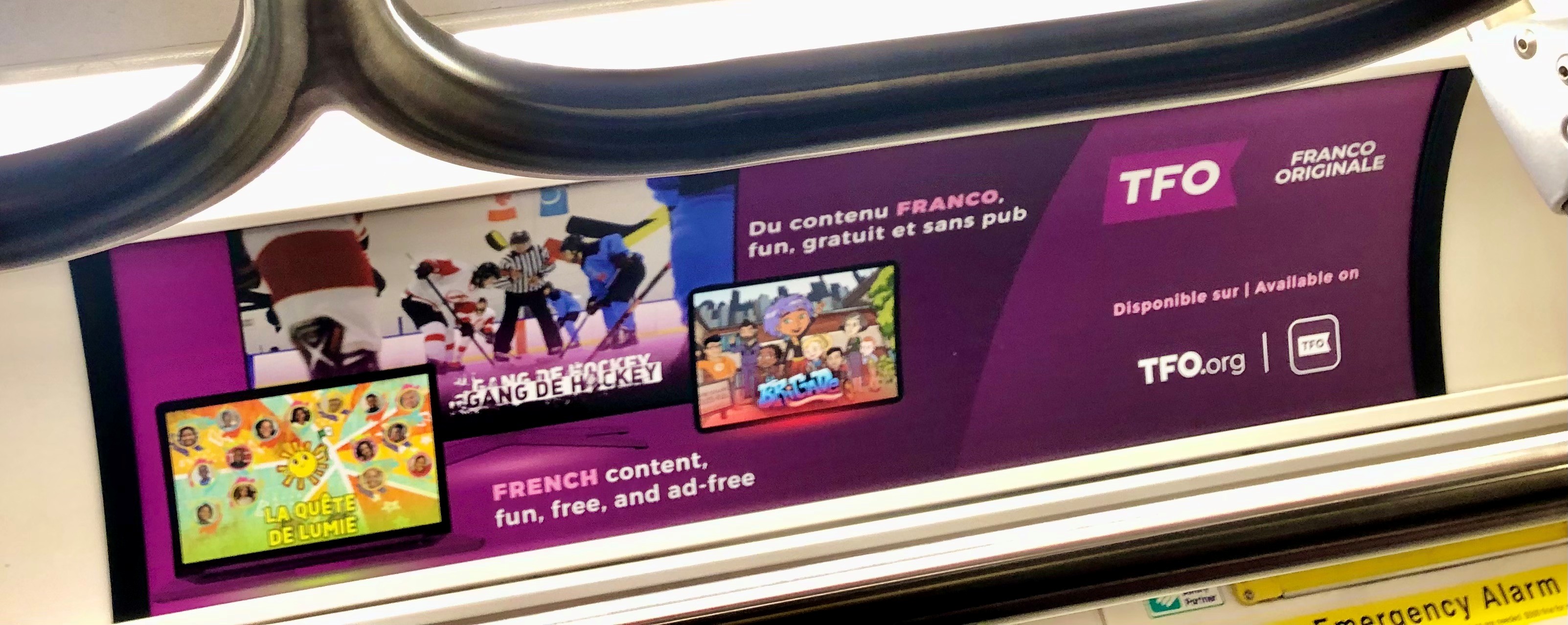
- We also noticed an ad campaign by Groupe média TFO on the Toronto subway in December 2024, which employed a fully bilingual format.
Cuts to French-language programs at Laurentian University
Report: Strengthening the Designation: A Collaborative Effort, March 2022
This investigation concluded that Laurentian University, the Ministry of Francophone Affairs and the Ministry of Colleges and Universities (as it was then called) did not meet their obligations under the French Language Services Act when Laurentian cut programs during its financial restructuring in 2021. The report made 19 recommendations, all of which were accepted.
The university and the two ministries have continued to report back to us on their progress in implementing these recommendations.
The Commissioner has determined that five of the 19 recommendations have been adequately implemented. Among other things, the university revised its bilingualism policy and implemented a process to ensure consultation with the Ministry of Colleges, Universities, Research Excellence and Safety (MCURES) and the Ministry of Francophone Affairs (MFA) before making any future changes that could have an impact on its designation.
The MCURES has put in place a governance structure to ensure that it will react quickly to any changes that could affect Laurentian University’s compliance with the French Language Services Act.
The MFA had already announced that starting in the fall of 2025, annual reminders would be sent to designated agencies to reiterate their French language services obligations through a new automated designation tool.
The Ministry also considered, as recommended, adopting a standard nomenclature for the designation of post-secondary institutions – however, after conducting an analysis, it decided not to do so “considering the variety and pace of evolution of French-language programs, certificates and services in French-language and bilingual post-secondary institutions.” Similarly, the Ministry assessed, as recommended, the implications of designating degrees, as opposed to degree programs, at Laurentian University – but determined that it does not intend to change the university’s current designation status.
We will continue to monitor progress on the remaining recommendations.
Follow-up to previous annual reports
Each year, in accordance with the French Language Services Act, we submit a report that must include recommendations to improve the delivery of French-language services in Ontario. Our practice is to follow up on all recommendations from previous reports and report publicly on the status of their implementation, where appropriate.
Last year, we recommended that the Ministry of Francophone Affairs create a comprehensive digital directory of services covered by the FLSA so that Ontarians can easily find French language services across the province.
In an interview with ONFR, Minister of Francophone Affairs Caroline Mulroney said she was working on the development of a directory of French-language services, stressing that it was an important project.
“[The Minister confirmed] she was working on developing a directory of services in French […].
‘I don’t know how long it will take, but it’s a big project, an important project,’ she said, following the recommendation of the French Language Services Commissioner in his latest report.” [Translation]
— Interview in French with Francophone Affairs Minister Caroline Mulroney by ONFR, published on onfr.tfo.org, June 24, 2025
The ministry of Francophone Affairs told us that it is currently working with Cabinet Office and the Ministry of Public and Business Service Delivery and Procurement to assess the feasibility of creating a digital inventory and next steps.
We will continue to closely monitor progress on this recommendation.
University of Sudbury
Our team continued the work begun in the summer of 2023 when we received 115 complaints following the decision of the Ministry of Colleges and Universities (as it was then called) not to provide funding to the University of Sudbury, a designated university under the FLSA. While we do not look at policy decisions, we do examine the compliance of the university, the Ministry of Francophone Affairs, and what is now called the Ministry of Colleges, Universities, Research Excellence and Security with their obligations under the FLSA.
We have been in regular discussions with all three parties regarding the university’s return to full compliance with the obligations of the FLSA.
The Commissioner urged the Ministry of Colleges, Universities, Research Excellence and Safety to address the situation as soon as possible and to provide him with updated and detailed information on the concrete actions it is taking to ensure that the University of Sudbury complies with the obligations set out in its designation. He also shared best practices from our Laurentian University investigation, including the importance of ongoing communication between ministries and designated agencies and the regular assessment of these agencies’ obligations under the FLSA.
On July 7, 2025, the Ontario government announced funding for the Health Sciences, Management and Business, Social Sciences and Arts programs that have been offered in partnership with the University of Ottawa since last September at the University of Sudbury.
Since the university’s current designation indicates “the provision of French-language and bilingual undergraduate programs leading to a Bachelor of Arts” while the new programs will lead to Bachelor of Commerce, Health Sciences and Science, the university told us that it plans to conduct an analysis of the terms of its designation in Regulation 398/93 soon.
Appendix
Cases received by the French Language Services Unit
Total: 2,155
- MAY 1, 2019 to MARCH 31, 2020 (11 months): 321
- APRIL 1, 2020 to SEPTEMBER 30, 2020 (6 months): 110
- OCTOBER 1, 2020 to SEPTEMBER 30, 2021: 351
- OCTOBER 1, 2021 to SEPTEMBER 30, 2022: 277
- OCTOBER 1, 2022 to SEPTEMBER 30, 2023: 386
- OCTOBER 1, 2023 to SEPTEMBER 30, 2024: 395
- OCTOBER 1, 2024 to SEPTEMBER 30, 2025: 315
List of recommendations 2019-2025
2024-2025
- That the Ministry of Francophone Affairs establish a framework with clear parameters to support all organizations subject to the French Language Services Act in the interpretation of Regulation 671/92 in promoting a very limited application of exemptions, and that it provide us with a copy of it.
2023-2024
- That the Ministry of Francophone Affairs compile a complete digital directory of services in French that are covered by the French Language Services Act and offered directly to the population. The directory should include the geographic location of these services, and should be easily accessible by the public.
- That the Ministry of Francophone Affairs report to the Commissioner in six months on the progress made in the implementation of Recommendation 1, and every six months thereafter until the Commissioner is satisfied with the progress.
2022-2023
- That, within the next 12 months, the Ministry of Francophone Affairs develop and communicate guidelines for all government agencies, third parties and institutions of the Legislature to ensure all social media accounts comply with Regulation 544/22, and provide a copy of these guidelines to the Commissioner.
- That Treasury Board direct every government ministry and agency within its mandate to provide regular training and reminders to all frontline staff where an obligation exists to provide services in French.
- That, as part of the directions, Treasury Board require these government ministries and agencies to attest annually that they are compliant.
- That, within the next 12 months, Treasury Board provide the Commissioner with a copy of the directions, and confirmation of their implementation.
2021-2022
- That the Treasury Board Secretariat review the Ontario Public Service employment policy to ensure that job postings in French are not limited to designated bilingual positions.
- That, by September 30, 2023, the Ministry of Francophone Affairs develop a plan, addressed to the Commissioner, to update Regulation 398/93.
2020-2021
- That Ontario government services in French be evaluated using the French Language Services Commissioner’s linguistic Compass (FLSC Compass).
2019-2020
- That the government systematically plan to offer services in French at press briefings.
- That the government ensure that the communication of all public health information be provided in French and English simultaneously.
- That the Ministry of the Solicitor General and the Ontario Provincial Police continue their efforts to guarantee an equivalent offer of services in French, and without delay, when issuing emergency alerts.
- That the government plan for the provision of equivalent French language services, without delay, where required by the French Language Services Act and its Regulation 284/11 regarding third parties.
- That the government regularly assess its capacity to offer services in French, particularly for frontline services.
- That the government ensure that regular updates are provided to staff, particularly frontline staff, on French language services policies and practices.
- That each Deputy Minister table a plan to the Executive Council that reports annually on the implementation of the French Language Services Act and the quality of French language services for the ministry for which they are responsible.
- That, as part of her obligation under the French Language Services Act to submit an annual report on the activities of the Ministry of Francophone Affairs to the Lieutenant Governor in Council and to the Legislative Assembly, the Minister of Francophone Affairs report annually, beginning April 1, 2022, on the plans tabled by Deputy Ministers and their implementation.
Cases received about organizations subject to the French Language Services Act*, October 1, 2024 – September 30, 2025
Organizations | Percentage |
|---|---|
| MINISTRY OF PUBLIC AND BUSINESS SERVICE DELIVERY AND PROCUREMENT | 14.6% |
| ELECTIONS ONTARIO | 9.6% |
| MINISTRY OF TRANSPORTATION | 9.2% |
| MINISTRY OF THE SOLICITOR GENERAL | 7.7% |
| MINISTRY OF HEALTH | 7.7% |
| MINISTRY OF THE ATTORNEY GENERAL | 5.8% |
| ONTARIO HEALTH | 5.4% |
| METROLINX | 3.8% |
| MINISTRY OF CHILDREN, COMMUNITY AND SOCIAL SERVICES | 3.8% |
| TRIBUNALS ONTARIO | 3.5% |
| DESIGNATED AGENCIES - HEALTH & LONG-TERM CARE | 3.5% |
| MINISTRY OF LABOUR, IMMIGRATION, TRAINING AND SKILLS DEVELOPMENT | 2.3% |
| DESIGNATED AGENCIES - POSTSECONDARY INSTITUTIONS | 2.3% |
| MINISTRY OF EDUCATION | 1.9% |
| MINISTRY OF COLLEGES, UNIVERSITIES, RESEARCH EXCELLENCE AND SECURITY | 1.5% |
| MINISTRY OF LONG-TERM CARE | 1.5% |
| MINISTRY OF THE ENVIRONMENT, CONSERVATION AND PARKS | 1.5% |
| MINISTRY OF FRANCOPHONES AFFAIRS | 1.2% |
| OMBUDSMAN OF ONTARIO | 1.2% |
| OTHER BOARDS, COMMISSIONS & CORPORATIONS | 5.0% |
| OTHER MINISTRIES | 4.2% |
| OTHER DESIGNATED AGENCIES | 1.9% |
| OTHER INSTITUTIONS OF THE LEGISLATURE | 0.8% |
*Ministries, boards, commissions, corporations and agencies designated under the French Language Services Act.
Regional Breakdown of cases received about organizations subject to the French Language Services Act, October 1, 2024 – September 30, 2025*
- Centre: Includes the SIMCOE, DURHAM, PEEL, HALTON, YORK, and TORONTO areas: 40.1%
- East: Includes BELLEVILLE, KINGSTON, BROCKVILLE, OTTAWA, HAWKESBURY, PEMBROKE, and CORNWALL: 27.5%
- North: Includes THUNDER BAY, NORTH BAY, GREATER SUDBURY, TIMMINS, NIPISSING, COCHRANE, and KENORA: 13.2%
- Southwest: Includes HAMILTON, THE NIAGARA REGION, WINDSOR, SARNIA, KITCHENER-WATERLOO, and LONDON: 19.2%
*All cases where a postal code is available.
Meeting with and listening to the Franco-Ontarian community
The following is a list of key outreach activities – virtual and in-person – between October 1, 2024 and September 30, 2025.
- Toronto, October 17, 2024 – Presentation to the Toronto Advisory Committee on Francophone Affairs.
- Ottawa, October 17-19, 2024 – Speech at the Annual Convention of the Assemblée de la francophonie de l’Ontario, and booth over the two days.
- London, October 29, 2024 – Remarks regarding health case at the regional meeting of Entités
1 and 2. - Toronto, November 1, 2024 – Remarks at the opening ceremony of the 12th edition of National Francophone Immigration Week in Central and Southwestern Ontario.
- Sarnia, November 4, 2024 – Interview with The Independent, Lambton.
- Penetanguishene, November 11, 2024 – Interview with Le Goût de vivre.
- Penetanguishene, December 5, 2024 – Interview with Le Goût de vivre.
- Ottawa, December 5, 2024 – Interview with Unique FM.
- Montreal, December 5, 2024 – Interview with Le Devoir.
- Toronto, December 5, 2024 – Radio interview with Radio-Canada program “Jonction 11-17.”
- Toronto, December 5, 2024 – Radio interview with Radio-Canada program “Le matin du Nord.”
- Toronto, December 5, 2024 – Interview with Radio Canada program “Le Téléjournal.”
- Toronto, January 28, 2025 – Interview for the CHOQ FM series on immigration, “Résonnance de l’Immigration.”
- Toronto, February 26, 2025 – Participation as a judge in the Université de l’Ontario français competition “Délie ta langue.”
- Toronto, February 28, 2025 – Remarks at the Centre francophone du Grand Toronto’s Black History Month Celebration Gala.
- Toronto, March 6, 2025 – Speech at Massey College’s “Déjeuner de la francophonie.”
- Toronto, March 6, 2025 – Interview with L’Express.
- Toronto, March 8, 2025 (virtual) – Video message for the celebration of International Women’s Day organized by Oasis Women’s Centre.
- Mississauga, March 19, 2025 – Speech at an active living fair for seniors organized by Heritage Welcome Centres and Peel Active Retirement.
- Toronto, March 20, 2025 – Participation at the International Francophonie flag-raising at Toronto City Hall, organized by ACFO-Toronto, the Consulate of France in Toronto and the Fédération Tricolore de Toronto.
- Toronto, March 20, 2025 – Interview with Radio-Canada.
- Toronto, March 27, 2025 – Speech at the Forum on Improving Access to French-Language Health Care in the Greater Toronto Area, organized by Entités 3 and 4.
- Ottawa, April 8 and 9, 2025 – Visit to the Ottawa area to meet with Francophone organizations: The Ottawa Hospital, Centre Le CAP, Action ontarienne contre la violence faite aux femmes, the Fédération de la jeunesse franco-ontarienne, the Centre d’établissement de soutien et d’orientation communautaire, the Réseau des services de santé de l’est de l’Ontario, the Mouvement d’implication francophone d’Orléans, and the Association pour l’intégration sociale d’Ottawa.
- Ottawa, April 9, 2025 – Interview with Unique-FM.
- Ottawa, April 10, 2025 – Radio interview with Radio-Canada program “Les matins d’ici.”
- Ottawa, April 10, 2025 – Interview with University Affairs.
- Toronto, April 25, 2025 – Interview with CHOQ-FM.
- Toronto, April 25, 2025 – Speech at the launch of the Réseau VIVRE+ Fierté organized by the Fédération des aînés et des retraités francophones de l’Ontario.
- Sudbury, May 3, 2025 (virtual) – Speaking at the Annual Parent Conference of Parents partenaires en éducation.
- Penetanguishene, May 29, 2025 – Visit to the Penetanguishene area to meet with Francophone organizations: La Clé de la Baie, the Conseil scolaire catholique MonAvenir, École élémentaire catholique Sainte-Croix, Collège Boréal, Simcoe County, Chigamik and Georgian Bay General Hospital.
- Toronto, May 30, 2025 – Remarks at the 30th Anniversary Celebration of Oasis Women’s Centre.
- Toronto, June 4, 2025 (hybrid) – Outreach event co-hosted with the Office of the Information and Privacy Commissioner of Ontario to share information with Francophones about access to information rights and French language services.
- Toronto, June 4, 2025 – Interview with L’Express.
- Kingston, June 6 and 7, 2025 – Speech at the annual convention of the Association des juristes d’expression française.
- London, June 10, 2025 – Speech at the 2025 Provincial Forum of the three Francophone Immigration Networks.
- Toronto, June 12, 2025 – Speech at the convocation of the first graduating cohort at the Université de l’Ontario français.
- Aurora, June 17, 2025 (virtual) – Video message for Entité 4’s Annual General Meeting.
- Welland, June 17, 2025 (virtual) – Video message for Entité 2’s Annual General Meeting.
- Toronto, June 17, 2025 – Speech at the launch of a poster campaign by the Centre francophone du Grand Toronto.
- Scarborough, June 19, 2025 – Visit to the TAIBU Community Centre.
- Toronto, June 26, 2025 (virtual) – Video message for Entité 3’s Annual General Meeting.
- Sudbury, September 24 – Visit to the Sudbury area to meet with Francophone organizations: Science North, Northern Ontario School of Medicine, launch of Groupe TFO’s back-to-school program.
- Sudbury, September 25 – Participation at celebrations marking the 50th anniversary of the Franco-Ontarian flag at Laurentian University and at the University of Sudbury.
- Toronto, September 27 – Speech at the FrancoQueer Annual General Meeting.
- Toronto, September 30 (virtual) – Speech at La Maison’s Annual General Meeting.
Our mission
To be an effective agent of positive change for the people of Ontario by enhancing government and public sector fairness, accountability and transparency, as well as promoting a respect for rights.
Our vision
A public sector that serves Ontarians in a way that is fair, accountable, transparent and respectful of their rights.
Our principles
Impartiality: We do not take sides when resolving complaints or investigating concerns. Our decisions and recommendations to improve public services are based on the facts and the evidence.
Independence: We are independent. We do not take directions from government, public sector agencies, interest groups or individual complainants.
Confidentiality: Our reviews, resolutions, and investigations are done in private. Protecting the confidentiality of those who contact us is central to how we work.
Fairness: We work to ensure that government and the broader public sector act in a fair, open, and transparent manner when delivering public services and programs.
Our values
Trust: We seek to build appropriate and productive relationships based on trust and credibility.
Respect: We treat everyone with dignity and respect and strive to listen and respond with compassion.
Accessibility: Our services are free and accessible.
Excellence: We strive to achieve the highest professional standards through the delivery of efficient and timely services and impactful, high-quality work.